

Here is the part that does not make it into the product photos. A knee brace with side stabilizers is a piece of equipment, and equipment has to be put on, adjusted, worn, and taken off. I am 63 years old. I spent 31 years as a union pipefitter kneeling on concrete and climbing ladders, and my left knee has osteoarthritis in it. Last winter I stepped down off the dock at Mark Twain Lake, felt the knee slide sideways, and grabbed a piling to keep from going in the water. That is the day I ordered the DR. BRACE Elite. Eleven months later I can tell you what it does, what it does not do, and who should keep their money.
This is not a review written after a weekend. I have worn this brace on every fishing day since January, and on the long stair days when Carol and I help one of our kids move furniture. It rides in my tackle bag in the garage. I have never worn it to bed. I have never worn it in the pool at the Y. Those two facts tell you more about the brace than any spec sheet, so I am putting them up front.
The Quick Verdict
A well-built brace that steadies a wobbly knee on ramps, docks, and stairs. It is bulky, it takes a minute to get on, and it will not fix anything by itself.
Amazon Check Today's Price →If your knee gives out on the step down, start here
This is the one that lives in my boat bag for ramps, docks, and stairs. Check the sizing chart on Amazon before you order, because fit is the whole ballgame.
Amazon Check Today's Price on Amazon →How I've Used It
I bought the DR. BRACE Elite in January, a week after the dock. My orthopedist diagnosed the arthritis when I was 58 and told me then that the name of the game was keeping the muscles around the knee strong. He did not tell me to buy a brace. My physical therapist did not either. I bought it because I wanted something between me and another sideways slip, and because standing on a dock for four hours with a crappie rod is a lot of standing on a knee that does not trust itself anymore.
The rule I settled on is simple. Brace on for fishing days and for stair days. Getting in and out of a 14 foot jon boat, walking the ramp, standing on the dock, that is when I wear it. I also wear it when we are carrying boxes up and down the stairs at one of the kids' places. For Tater's two walks a day around the neighborhood I do not wear it. That is the Modvel sleeve's job. The brace lives in the tackle bag, which tells you how I think about it. It is gear, not underwear.
I have never slept in it. I have never taken it into the pool. Neoprene and chlorine do not need to meet, and I do not want to find out what a wet brace smells like after a week in a bag. Twenty minutes of water walking at the Y is the one place I want nothing strapped to my leg.
The first week I wore it around the house for an hour at a time to figure out the straps before I took it to the lake. That was worth doing. Showing up at the ramp with a brace you have never adjusted is how you end up with a numb foot and a bad mood before you ever get the boat in the water.
The first real test was a Saturday in the middle of January, 34 degrees when I backed the trailer down the ramp at Mark Twain. There was skim ice in the shallows off the courtesy dock and I stood there in two pairs of wool socks with my left pants leg hiked up over the brace, feeling like a fool in front of two fellows who were already fishing. Then I put my hand on the gunwale and stepped over onto the deck. The knee did not slide. It has not slid since, not once, in eleven months of getting in and out of that same boat. I am not going to tell you the brace is the only reason. I have been doing the PT work too, the straight leg raises and the wall sits, most mornings in the living room before Carol is up. But that step over the gunwale is the exact motion that put me on the dock holding a piling, and I notice that it does not scare me anymore.
What the Side Stabilizers Actually Do
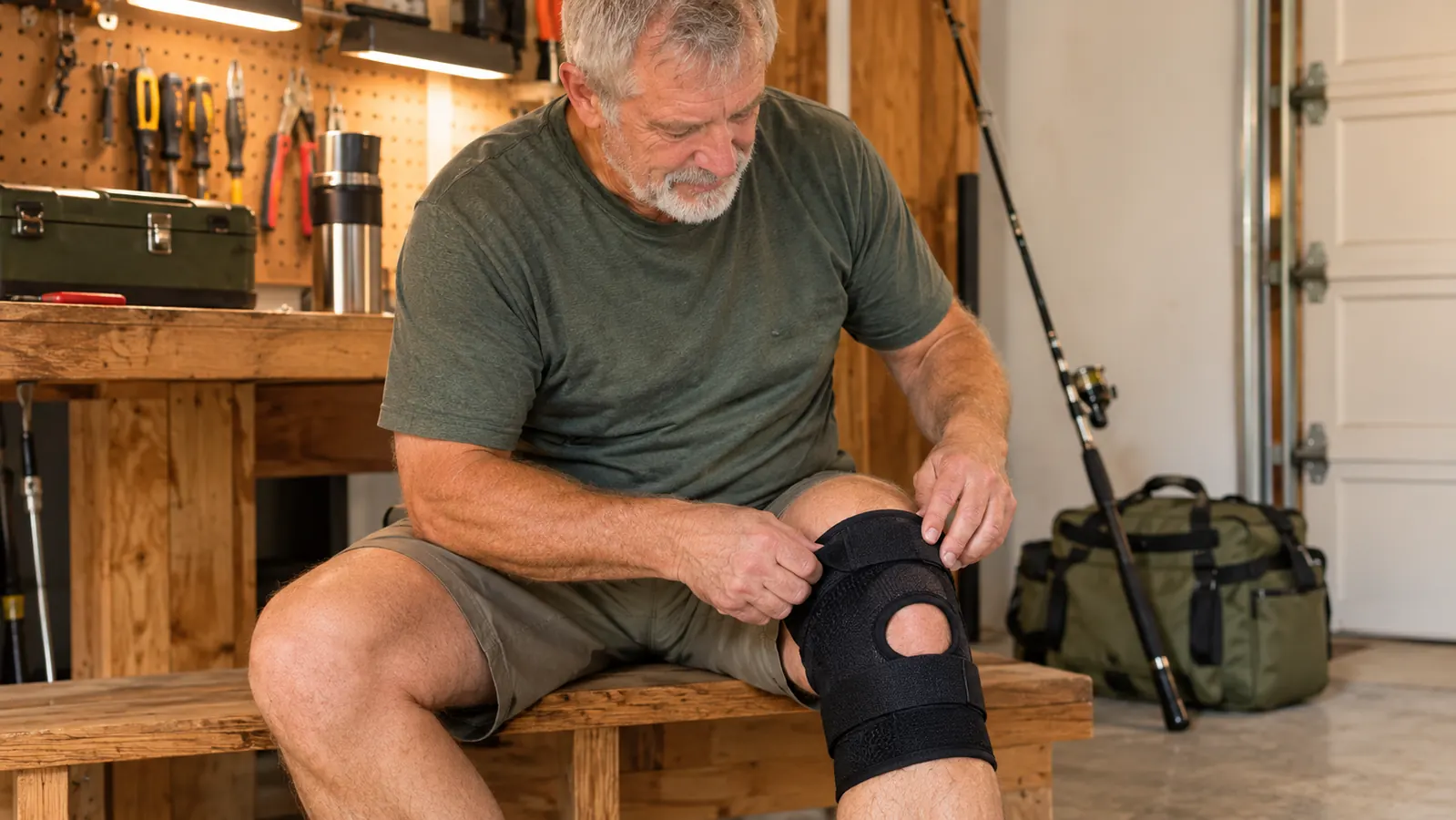
The DR. BRACE Elite has flexible springs sewn into the side panels. The listing calls them side stabilizers, and that is the right word for them. They are not hinges. There is no metal joint that locks the knee into a fixed arc, and anybody who tells you a soft brace like this one is a hinge brace is selling you something. What the springs do is resist the sideways drift, the little inward or outward slide that happens on a slope, a wet dock plank, or a step that is not where you thought it was. My knee wants to drift inward when I step down. With the brace on, that drift has something pushing back against it.
Last April I came down the state park ramp after a rain with a bucket of minnows in one hand and my rod in the other, and the plank at the bottom was slick as a wet countertop. The left foot went down and the knee started to roll in. It caught. I do not know how else to describe it. The drift stopped partway and I got my weight back over the foot. I would have gone down three years ago. That is not a promise that it will catch every time. It is one morning I remember, on one plank, in the rain.
What they do not do is hold me up. Nothing strapped to the outside of my leg is going to carry a retired pipefitter down a flight of stairs. If the quad quits, the brace quits. That is why I still do the exercises the PT gave me, the straight leg raises, the wall sits, the step ups on the bottom stair. The brace buys me a little margin. The margin itself comes from muscle, and it takes months to build.
So this is the part I would tell anybody. Do not buy this instead of doing the work. Buy it because the work takes months and the dock is next Saturday.
The Bulk Is Real
The brace is not a sleeve. It is layers of nylon, neoprene, polyester and spandex with a gel ring around the kneecap and those springs down the sides, and it sits on your leg like a piece of gear. Under a pair of jeans it shows. Under a pair of jeans that actually fit, it shows a lot. The first time I wore it to the hardware store I caught the pant leg on the top strap twice getting out of the truck.
My answer was to stop fighting it. On fishing days I wear shorts or loose canvas work pants, and I put the brace on before the pants. If I am going somewhere I care about how I look, I do not wear it. That is a real tradeoff, and it is the one thing the five star reviews skip, because everybody photographs the brace on a bare leg in a living room.
Getting it on takes about a minute. You slide it up, get the gel pad centered around the kneecap, pull the straps around, and snug them down. The straps are adjustable and there is enough length in them for a heavy calf, which I have. The first week I had it too tight and my foot went to sleep on the drive to the lake. Loosen it. You want snug, not tourniquet.
For reference, my left thigh measures a hair over 19 inches around, six inches above the kneecap, and my calf is 16. The brace is a Large according to the size chart and there are still several inches of strap left over at the ends. Before this I tried to solve the dock problem with the compression sleeve I already owned, the one I walk Tater in. It is fine for a neighborhood walk. On a wet dock plank it rolled down behind my knee inside of twenty minutes and it does nothing at all about sideways drift, because there is no spring in it and nothing to resist the knee turning in. I wanted the cheap thing to work. It was not built for that job, and no slip-on sleeve is.
The brace did not make my knee younger. It made the step down off the dock less of a gamble, and that was the whole job.
Fit, and the Parts Nobody Mentions
Fit is where this thing earns its keep or ends up in a drawer. The adjustable straps give you a 360 degree wrap, and the silicone strips inside keep it from sliding down your leg. On my leg it stayed where I put it through a four hour fishing morning, which is more than I can say for a slip on sleeve once I start sweating. The tradeoff is the silicone itself. It grabs leg hair. If your legs are hairy, the first few times you peel this off you will know it.
The patella gel pad is the other thing nobody explains. It is a ring, not a cushion you plant the kneecap on, and it needs to sit around the kneecap rather than on top of it. Get it wrong and the brace feels like it is poking you in the knee. Get it right and you forget it is there. That took me three or four tries to figure out.
The box also came with a rubber band and a printed weekly exercise program. The band is a light one and the sheet is basic, the kind of thing any clinic hands out. My PT's program is better for me because he knows my knee. But if you have nothing to start with, the sheet is a place to start, and starting beats not starting.
Sizing deserves its own paragraph, because the straps are the adjustment and the panel is the structure. A medium on a leg my size would have put the springs in the wrong place on my calf, and no amount of strap tightening fixes that. For my first month I wore the whole thing about an inch too low, with the gel ring sitting directly on the kneecap instead of around it, and I spent a Saturday morning in February convinced the brace was defective. It was not defective. I had it in the wrong spot. Slide it up until the ring frames the kneecap, then tighten the top strap first and the bottom one second, and check it in the bathroom mirror before you walk out the door. I do that every time now, in the garage, off the reflection in the truck window.

Heat, Sweat, and the Long Day
The listing says lightweight and breathable fabric, and for a brace with neoprene in it, it is. That is not the same as cool. By hour three on the dock in July, the back of my knee is damp and the brace has to come off for a minute while I stand in the shade and let the air get to it. I have not had a rash. I have had a sweaty leg.
The bigger nuisance for me is the back of the knee. The straps and the fabric bunch behind the joint when I bend it deep, like getting down into the boat. I have learned to reach back and smooth everything down before I stand up. Small thing. It is also the kind of small thing that makes people leave a brace in the closet after two trips.
July is the honest test. I am usually on the water by 6:30 and off by noon. By 9:30 on a still morning the back of the knee is damp and the whole thing has warmed up against the skin. On a breezy day it is fine. On a dead calm one I take it off on the tailgate, wipe the inside down with the towel I keep behind the seat, and let it air while I eat a sandwich and Tater naps in the shade under the truck. Ten minutes later it goes back on. It has not gone sour, the gel ring has not cracked, and I have never had a rash from it, which is more than I can say for a pair of work boots I wore for a decade.
The Two Things I'd Change
If I could change two things, the first would be the strap ends. There is a fair amount of tail left after you snug them down, and it flaps on a windy dock. I tuck mine under the next strap and get on with it. The second would be the fabric behind the knee. It is a little heavy back there for a joint that has to bend deep. Neither of those is a deal breaker. Both are the sort of detail you only learn after a month, and I would rather tell you now than have you find out on the water.
What I Liked
- The side springs steady the knee on ramps, docks, and uneven ground.
- Adjustable straps and silicone strips keep it where you put it, even on a sweaty day.
- The patella gel pad sits around the kneecap and stays put once you get it centered.
- It has held up through 11 months of fishing days without a seam letting go.
Where It Falls Short
- Bulky. It shows under jeans and catches on a pant leg.
- Takes about a minute to put on and adjust, not a slip-on.
- Warm in summer, and the back of the knee bunches when you bend deep.
- The silicone strips tug leg hair when you take it off.
- It supports the knee. It does not strengthen it, and it will not replace PT.
Who This Is For
This is for the person whose knee wobbles on the step down, not the step up. Mine is fine going up the stairs at home and unreliable coming down, especially on a ramp or a wet dock plank. If that is your knee too, the side stabilizers are aimed right at your problem. It is also for someone with one specific task that scares them, a boat, a ladder, a move, a hunting trip, who wants a little margin for the day.
It suits a heavier leg, too. I am not a small man and the straps had room to spare. And it suits somebody who will put it on for the task and take it off after, not somebody looking for a brace to live in from morning to night.
One practical note. Measure your thigh and calf with a soft tape before you order and match it to the size chart. I would not guess at a size from a pant size, and I would not size up hoping to grow into it. Snug is the point.
Who Should Skip It
Skip it if you want a brace you can forget you are wearing. That is a sleeve, not this. Skip it if you are looking for something to sleep in, swim in, or wear under a suit. And skip it if you have not had a doctor or a PT look at the knee yet, because a brace can mask something that needs a look, and because the exercises matter more than the straps over the long haul.
Skip it if your knee buckles without warning. That kind of instability is a conversation with an orthopedist, not an Amazon order. And skip it if you are expecting the brace to be the fix. It is a tool. It helps me get in and out of a boat and down a flight of stairs with boxes in my arms. It does not change the fact that I have arthritis in my left knee and had a meniscus trimmed in my right one back at 47.
The brace that lives in the tackle bag, not the drawer
Eleven months, one dock, and a lot of crappie. If your knee needs margin on ramps and stairs, look at the DR. BRACE Elite and measure your leg before you pick a size.
Amazon Check Today's Price on Amazon →