
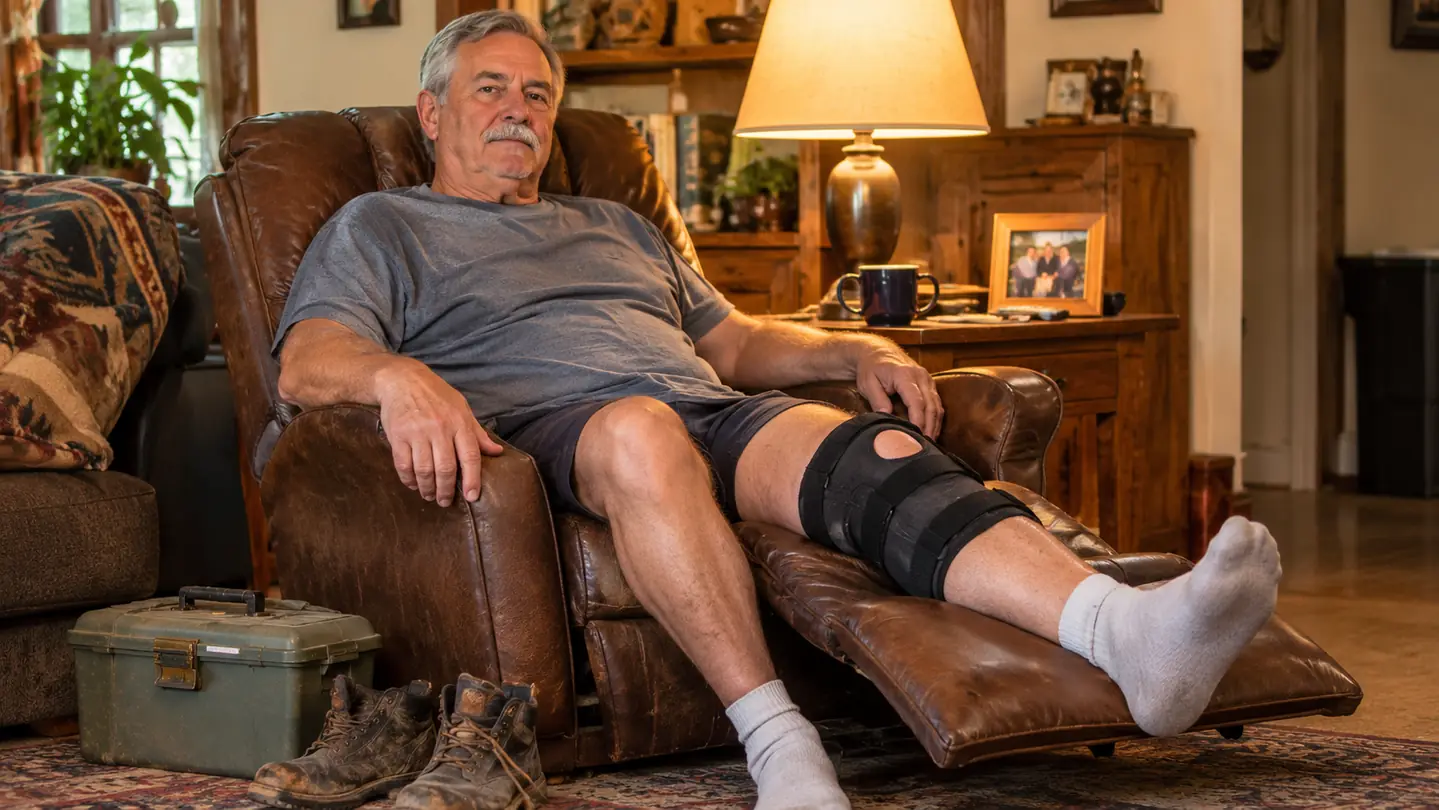
I am 63 years old, a retired union pipefitter, and I have arthritis in my left knee. A day of crappie fishing on Mark Twain Lake does not hurt while I am out there. The trouble starts when I climb out of the 14-foot jon boat, walk up the ramp, and lower myself into the truck. By the time I get home to St. Charles, the knee is puffy and stiff, and the stairs in our split-level house look like a mountain. I have been dealing with this since I was 58, when an orthopedist told me what it was.
Carol, my wife, got tired of watching me ice it with a bag of frozen peas wrapped in a dish towel. She bought me the Vive knee ice pack wrap about 14 months ago. It is a neoprene wrap with three reusable gel packs and four adjustable straps. I use it cold after fishing and warm in the morning before I walk Tater, our 9-year-old yellow Lab mix. I am not a doctor, and I am not going to pretend this is a cure. It is the tool that makes the bad evenings easier to get through.
Put the cold where the swelling is, while you are still thinking about it
The Vive wrap holds three gel packs against the front and back of the knee and lets you set the compression with four straps. I keep mine on a hook in the laundry room and the packs in the kitchen freezer, so it is ready when I come through the door.
Amazon Check Today's Price on Amazon →Step 1: Get off your feet and look at the knee before you do anything else
Fishing is a lot of standing and a lot of sitting in a small boat, and neither one is kind to an arthritic knee. When I get home, I do not go straight to the recliner and turn on the TV. I sit on the edge of the couch, put both feet on the ottoman, and take a good look at the knee. Is it swollen? Is it warm to the touch? Is there a red streak or a spot that was not there this morning?
Most of the time, it is the same old puffiness I get after a long day. That is when I go get the Vive wrap. If the knee is hot, red, or I cannot put weight on it, I call my doctor. I am not a medical man. My orthopedist diagnosed the arthritis at 58, and my physical therapist gave me the exercises I do at home. They are the ones who call the shots, not me and not a product page.
Five minutes with your leg up does two things. It lets you see what you are dealing with, and it keeps you from wrapping a knee that does not need wrapping. Most fishing days, mine needs it. Some days, it just needs a shower and a night of sleep. The point is to pay attention before you decide, not after.
Step 2: Load all three gel packs and get the cold on both sides of the knee
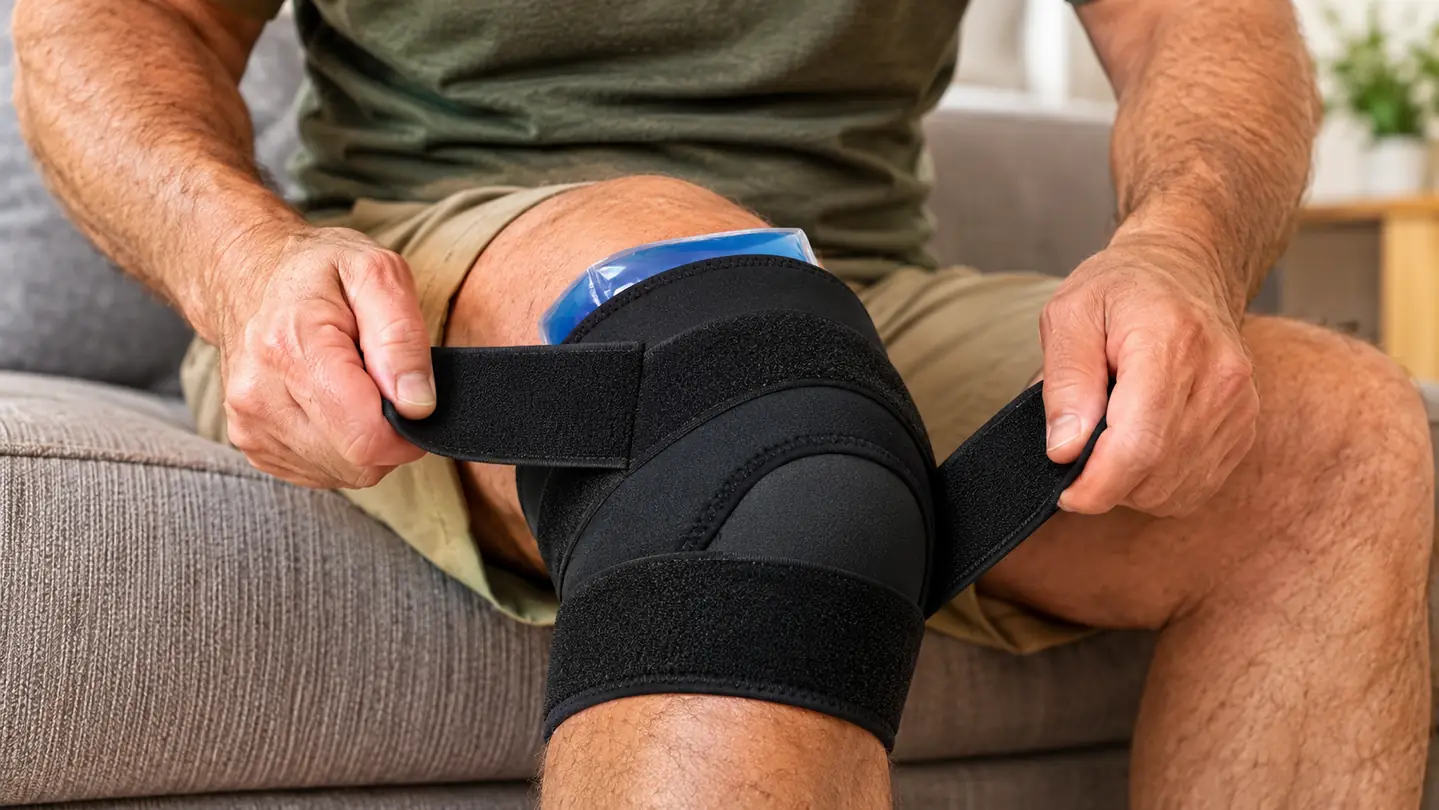
Cold is for swelling. My knee swells after fishing, after a long walk with Tater, and after a day of yard work. The Vive wrap is built to put cold on the front and the back of the knee at the same time. That matters because my swelling is not just on the front. The back of my knee gets tight, too, especially after I have been standing on the dock watching a bobber.
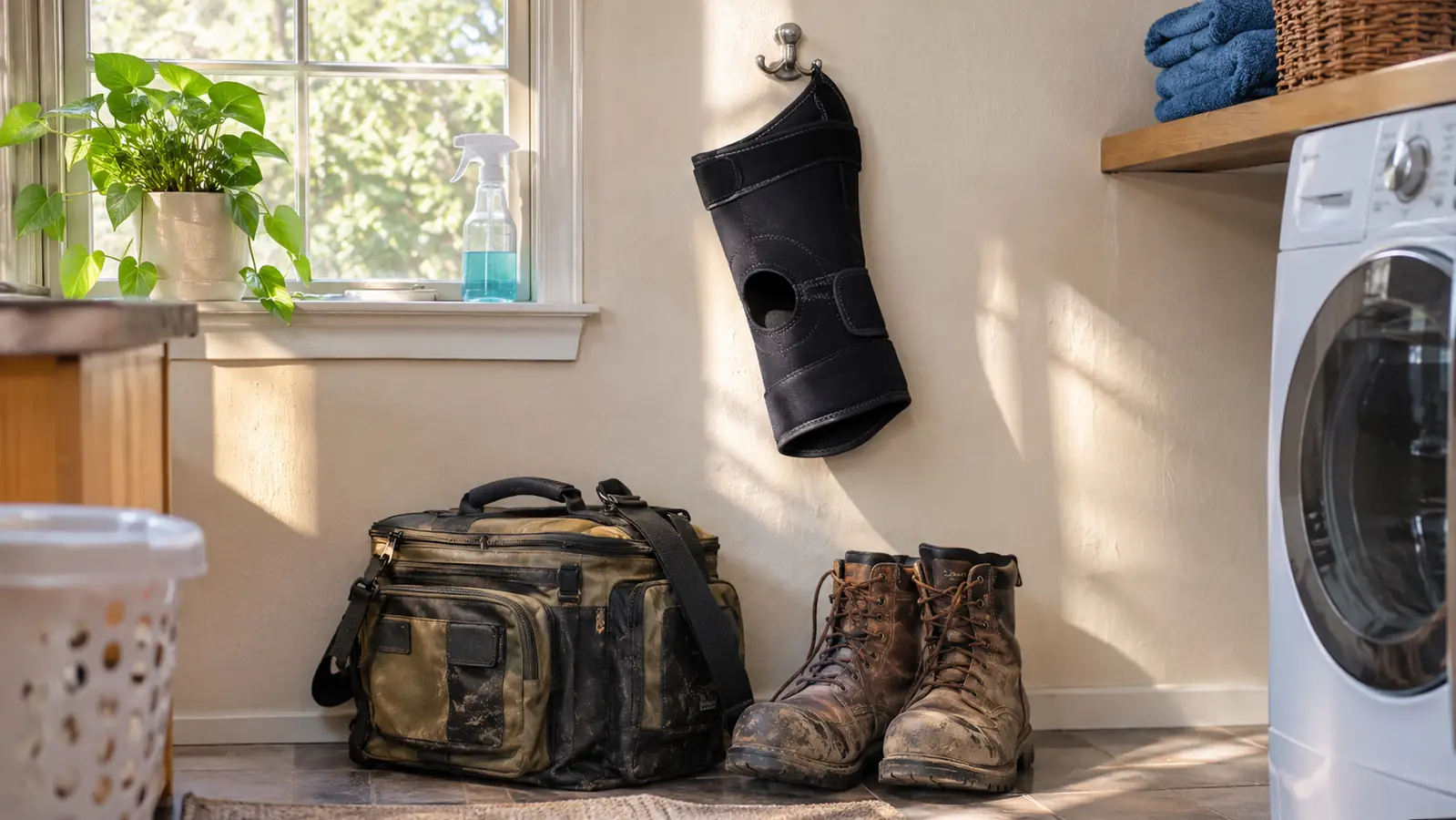
I keep all three gel packs in the kitchen freezer, in the door, where I can grab them without digging. When I come in from the lake, I take the wrap off the hook in the laundry room, slide the packs into their pockets, and put the wrap around my knee. The neoprene blend is lightweight, and the wrap is machine washable. I wash it every couple of weeks, by itself, and let it air dry. The rest of the time it hangs on the hook.
One thing I learned the hard way: do not put the wrap on over wet jeans or bare skin that is still sweaty from the ramp. Dry off, put on shorts or loose pants, and then wrap. It fits better and it does not slide. I also check that the packs are flat and not bunched up in one spot. The wrap is not complicated. It is a way to hold cold against the knee while you sit still. If you are going to get up and work in the garage, take it off first.
Step 3: Snug the four straps, then check them again after five minutes
The Vive has four adjustable compression straps with hook and loop. That is a mouthful. In plain English, you can tighten the top and the bottom separately. I tighten the top strap first, then the two middle ones, then the bottom. I want it snug enough to hold the packs against the knee, not so tight that I can feel my pulse in my toes.
The wrap fits knees up to 21 inches around. My knee is well under that, and I still have room to snug it down. If you are a bigger man than me, measure your knee before you order. A wrap that is too small will not do you any good, and a wrap that is too loose will slide down your leg when you stand up. The closure is hook and loop, so it is easy to adjust. It is also easy to yank too tight, which is why I check it twice.
After five minutes, check the straps again. The neoprene warms up, and the wrap settles. I usually take up one more notch on the top strap. Then I sit back. The wrap has a non-slip quality to it, and I can walk to the kitchen for water without it ending up around my ankle. I do not make a habit of walking around in it, though. It is a sitting-down tool. If your leg goes numb, tingles, or turns color, the straps are too tight. Loosen them. Compression is supposed to help, not cut off circulation.
Step 4: Set a timer, keep it to 20 minutes, and take it off
Cold therapy is not a case where more is better. I use the Vive cold for 15 to 20 minutes. That is what my physical therapist told me for cold packs, and it is what I have done for 14 months. I set the timer on the stove or my phone, because it is easy to get interested in a Chiefs game and forget.
Twenty minutes is enough for the knee to feel less puffy. It is not enough time for me to fall asleep, which is the real danger. I know a guy who fell asleep with an ice pack and woke up with a cold burn. I do not want to be that guy. When the timer goes off, the wrap comes off. I fold it, put the packs back in the freezer, and hang the wrap on the hook.
I check the skin after every use. It should be pink and cool, not white, gray, or numb. If it looks wrong, I leave the wrap off and call my doctor. The Vive has a 60-day guarantee, but no guarantee covers a burn you gave yourself by leaving it on too long. The timer is the most important part of the whole routine. If I am having a bad night, I do a second round after an hour, not right away. The skin needs a break. I use that hour to take a shower, eat supper, or let Carol tell me about her day. Then I check the knee. If it is still puffy, I put the cold back on for another 15 minutes. If it is not, I leave it alone.
Step 5: Use warmth in the morning, cold after the walk
Here is the part that took me a while to figure out. My knee is stiff in the morning, not swollen. Cold does not help stiffness. Warmth does. The Vive gel packs can go in the microwave. I warm them for a few seconds at a time, check them on my wrist, and then wrap the knee while I drink my coffee. By the time Tater is doing his dance by the door, the knee is looser.
I do not make them hot. I make them warm. Hot packs on old skin are a bad idea. Carol is the one who reminds me to test them on my wrist first. She has been doing that since I started this routine, and she is right. If the pack feels hot on my wrist, it is too hot for my knee. I let it sit for a minute and test it again.
After Tater's morning walk, if the knee is puffy, I switch back to cold. That is the whole system. Warm before, cold after. The wrap stays on the hook in the laundry room, and the packs stay in the freezer. If I had to go dig it out of a drawer, I would not use it. Put it where you will see it. That sounds like a small thing. It is not. On fishing days, I do not warm the knee before I leave. I am usually up before daylight, and I am not going to sit around with a warm pack when the crappie are biting. I do not put the wrap in the truck. I leave it at home. I use it when I get back. The cold after is the part that matters for me.
The cold does not fix the arthritis. It gets the swelling down enough that I can get up the stairs without holding the rail with both hands.
What Else Helps
I am not going to tell you the Vive wrap is the only thing I do for my knee. It is one piece. The others matter just as much, and none of them are optional if you want to keep fishing and walking the dog.
First, the exercises. My physical therapist showed me a handful of things to do at home, and I do them on the days I am not in the pool. Nothing fancy. Leg lifts, wall sits that are more like wall leans, and a stretch with a towel. Second, the pool. I swim laps and walk in the water at the St. Charles YMCA twice a week. The water takes the weight off, and I can move the knee without paying for it later. Third, my weight. I am not a small man, and every pound I carry is a pound my knee carries. I am working on it.
On bad nights, I use a TENS unit that my orthopedist said was reasonable to try. The PT showed me where to put the pads, around the kneecap, never on it. I also sleep with a foam pillow between my knees, because if they press together all night, I wake up at 3 a.m. with the ache. A light compression sleeve comes out for walks and yard work. The bigger brace comes out for fishing days and long stair days. Each one has a job. The Vive is the cold and heat job.
None of this is a cure. I still have arthritis. I still have days when the stairs are a chore. But I can fish, walk the dog, and get up and down my own house without dreading it. That is worth a lot to me. If you are where I was a few years ago, start with your doctor and your physical therapist. Then build a routine you will actually do. The best tool in the world does nothing if it stays in the drawer.
The best time to ice is before the knee stiffens up
If you fish, stand on a dock, or climb in and out of a boat, the Vive wrap gives you a way to put cold on the front and back of the knee for 15 to 20 minutes when you get home. Keep the packs in the freezer and the wrap where you can reach it. That is the difference between a routine and a good intention.
Amazon Check Today's Price on Amazon →