
I keep a 14-foot jon boat on a trailer, and I have a left knee that has been giving me notice since I was 58. For about two years that boat sat in the side yard more than it sat in the water at Mark Twain Lake. It was not the fishing that kept me home. It was the two feet of air between the dock and the bow.
If your knee has opinions, you know the problem already. Getting into a jon boat is not one motion. It is six small ones, and every one of them happens while the thing you are stepping onto is moving. I am not a doctor. I am a retired union pipefitter from St. Charles, Missouri, 63 years old, 31 years of kneeling on concrete and climbing ladders, with osteoarthritis in my left knee confirmed by an orthopedist when I was 58. What I can tell you is the order I do things in now.
The brace I use on boat days is the DR. BRACE ELITE. I have had it about 11 months, since last winter, and it lives in my tackle bag in the garage. It does not live on my leg. I wear it for fishing days, for the boat ramp, for time on the dock, and for long stair-heavy days like helping somebody move. Never to bed, never in the pool at the Y.
The dock is the hard part. This is what I put on for it.
Eleven months of wet docks and gravel ramps. Adjustable straps, a patella gel pad, and flexible side stabilizers that push back when the knee wants to fold sideways. Check the size chart against your measurement before you order, because fit matters more here than anything else.
Amazon Check Today's Price on Amazon →The Five Steps I Use Every Fishing Day
Step 1: Tie the boat off and load it before you step onto anything
The first change I made had nothing to do with my knee. I start by tying the bow line to a cleat so the boat cannot drift away from the dock while I am halfway into it. A jon boat is light. It moves when you breathe on it. Tie it off and it becomes a fixed object, and a fixed object is the only kind of thing worth stepping onto with a bad knee.
Next, everything goes in the boat before I do. Tackle bag, net, cooler, rod socks. I hand them down from the dock or set them on the floor from the bank. I do not carry anything in my hands when I step in, because both hands are part of the system. The one time I tried to carry a rod and a tackle bag at the same time, I got lucky and only came home with a wet boot.
Pick your spot, too. I use the widest, most stable stretch of dock, not the end where it bounces. If a bass boat just went by, I wait for the wake to quit slapping the hull. On a ramp, watch the concrete for green algae, because wet algae is worse than ice. That is a lesson from 40 years of fishing, not from my knee.
Step 2: Put the brace on standing up, before you leave the truck
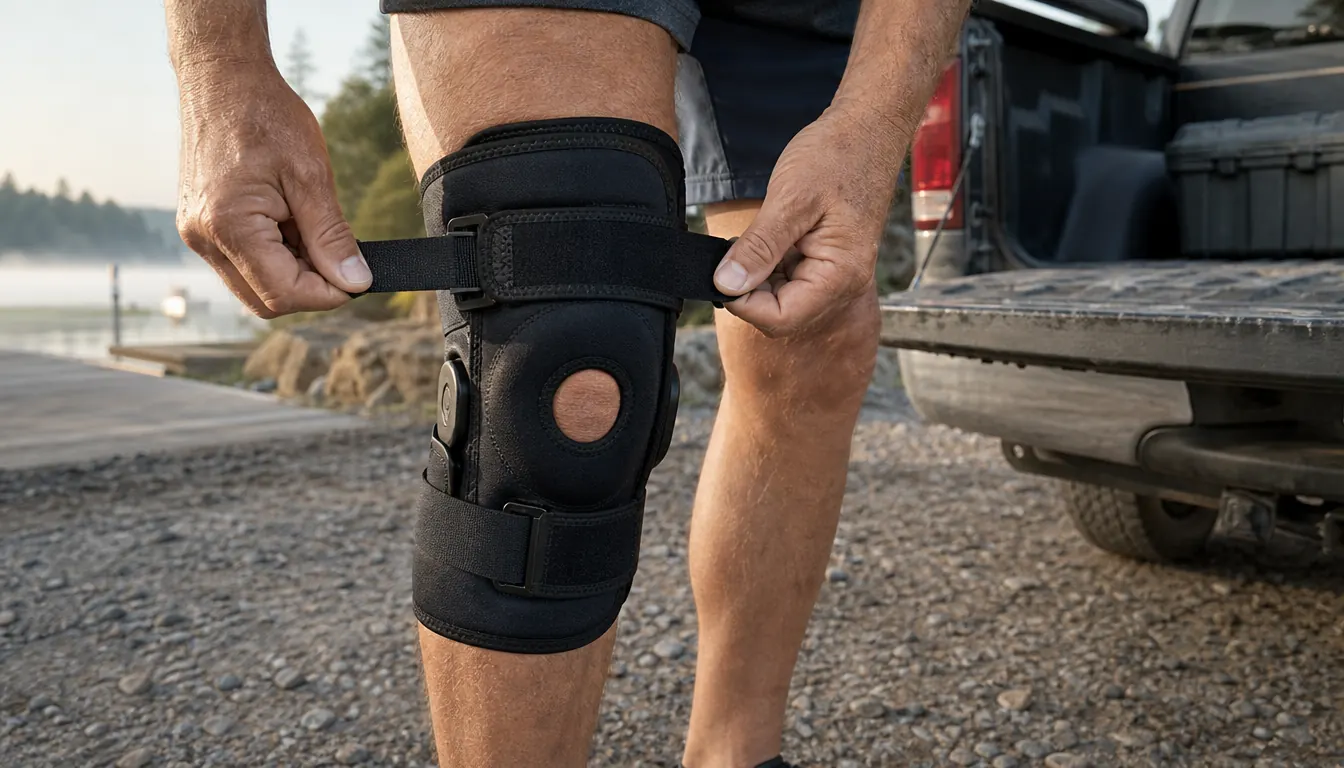
I put the brace on in the parking lot, standing beside the truck, not sitting inside with my leg bent. It goes on over dry skin. If I have been sweating, I dry the leg off first, because the brace has non-slip silicone strips at the top and bottom and they do not grip damp skin worth a hoot.
The patella gel pad goes directly over the kneecap. Then I work the straps snug from the bottom up. The straps wrap all the way around, and the two side panels have flexible springs in them. Springs, not hinges. That mattered to me, because a hinged brace I tried once felt like it was fighting me every time I sat down on a boat seat. These springs push back when the knee wants to wander sideways, then they let you bend.
How tight? I should be able to slide one finger under a strap without a fight. If the brace has slid down toward my shin by the time I reach the dock, it was too loose and I redo it. If my leg is throbbing and the skin is marked when I take it off, it was too tight. That is the whole fitting lesson.
Step 3: Sit down on the dock, then lower yourself in
Here is the mistake I made for years. I stepped over the gunwale like it was a ladder rung, bad knee first, one hand on nothing. It worked fine until the day my left knee wobbled on the way down and I sat down hard on the bench seat with my heart going. That wobble is what sent me looking for a brace in the first place.
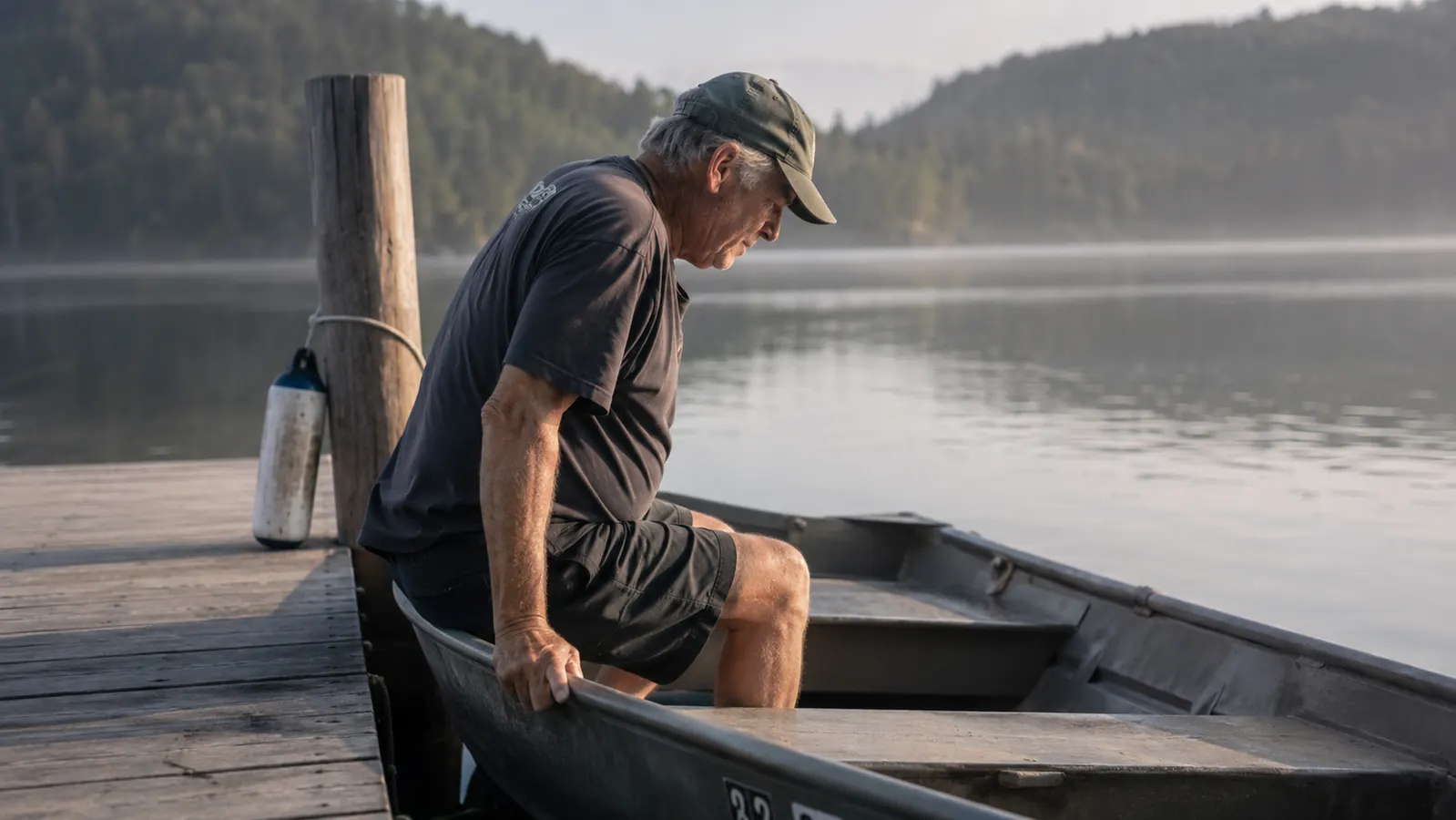
What I do now: I sit on the dock with my legs hanging over the edge, facing the boat. Both hands go on the gunwale. I slide my feet down to the floor of the boat, keeping them near the center line, then I lower myself to the seat. Three points of contact the whole way. Hands, seat, feet. I never step on a bench seat and I never step on the gunwale itself, because neither one is as solid as it looks.
The first time I did that with the DR. BRACE ELITE on, the change was not that the ache went away. The change was that the side-to-side wobble quit. My knee still had arthritis in it. It just stopped folding sideways on me during the two seconds when I had nothing to grab.
The brace did not make my knee younger. It made the two seconds between the dock and the boat stop being the reason I stayed home.
Step 4: Move around the boat from the seat, not from a locked knee
You do not stand up in a 14-foot jon boat to cast, or at least you should not. I keep my feet wide, I use the seat as a third leg, and I pivot rather than step. The brace stays on for the whole trip even though I am sitting most of it, because the getting up is the part that matters. Standing from a boat seat is a one-legged squat whether you meant to do one or not.
My way of standing up: slide to the front edge of the seat, put both feet flat under me, and push with both hands on my thighs. Carol says I look like an old man getting out of a lawn chair. I tell her that is exactly the point. The version where I lunge up off one leg is the version where I end up in the water.
The brace has held up fine through all of it. It is nylon, neoprene, polyester and spandex with the springs, and it is warm on a July morning in Missouri. I am not going to tell you it breathes like a T-shirt. It is a sleeve on your leg. I take it off at the truck at the end of the day, and that feels good.
Step 5: Get out the same way you got in, and do it before you are tired
The wobble that started all this was stepping down into the boat. The one that scared me was getting out at the end of the day, tired, with a limit of crappie in the livewell and the wind picking up. Tired legs make bad decisions, and a bad decision at the dock costs more than a bad decision anywhere else.
So I reverse it. I slide to the edge of the seat, put both hands on the dock, put both feet on the floor of the boat, and stand up onto the dock with my arms doing a good share of the work. The cooler and the tackle bag get handed up or set on the dock after I am up. I do not try to be a hero and carry things while I climb.
And I quit waiting until the bite dies. I come in while I still have legs left. That is not a sacrifice, it is arithmetic: two hours of fishing and an easy exit beats four hours of fishing and a bad one. If somebody offers to hold the boat against the dock while you get out, take the help. Carol has held that boat more times than I can count.
What the Brace Is Actually Doing
The DR. BRACE ELITE is a wrap-around brace with adjustable straps, a gel pad that sits over the kneecap, and those flexible springs in the side panels. The listing names arthritis along with ligament and meniscus issues and patella discomfort, and says the straps are meant to give support during everyday activity and walking. Nobody at the company told me it would fix my knee. What it does for me is narrow the gap between how much side-to-side play my knee has and how much I need it to have on a moving dock.
It comes with a rubber band, a manual, and a printed weekly exercise program. I looked at the program once and handed it to my physical therapist, who already had me on a better one. The brace is a tool, not a treatment. If I quit doing the exercises and just wore the brace, I would be right where I was two winters ago, only with a nicer-looking leg.
What Else Helps
The brace is one piece of it. The thing I reach for first after a fishing day is the Vive ice pack wrap, a neoprene wrap with three gel packs. Carol bought it after she caught me icing my knee with a bag of frozen peas. Cold for 15 to 20 minutes when the knee is puffy after a day on the boat. Warm in the morning before the first walk with Tater when the knee is stiff. Same wrap, different temperature.
In the evening I use the AUVON TENS unit for 20 to 30 minutes in the recliner, pads around the kneecap and never on it. My orthopedist said it was reasonable to try, and my PT showed me where the pads go. A few nights a week, low intensity, usually during a Chiefs game. And every night I sleep with the Contour Legacy foam pillow between my knees, because if I do not, my knees press together and I am awake at 3 a.m. That pillow is two years old and it is the simplest fix on the list.
The rest is boring and it works better than any of the gear. The home exercises my PT gave me, a couple of times a day. Water walking and lap swimming at the St. Charles YMCA twice a week, which is the only exercise where my knee never complains the next morning. And I let Carol nag me about wearing the brace instead of leaving it in the tackle bag because I am only running down to the ramp.
What This Does Not Fix
None of this is a cure, and I want to be plain about that. The arthritis is still in my knee. There are mornings I look at the weather and decide the boat stays on the trailer. The brace does not stop me from stepping wrong, it gives me a little more room to recover when I do. It also does nothing about a slick ramp at Mark Twain after a rain, which is a problem no piece of equipment solves.
It is also not a substitute for your doctor or your physical therapist. Mine call the shots on my knee and I do what they tell me. If your knee is new to this, get it looked at before you buy anything. If you have had a replacement, or the knee gives out without warning, that is a different conversation than mine, and it belongs with a professional rather than a retired pipefitter on the internet.
One less reason to leave the boat on the trailer
Eleven months, one tackle bag, and a lot of wet docks. If the step between the dock and the boat is what is keeping you home, this is the piece of gear I would start with. Measure first and match it to the size chart.
Amazon Check Today's Price on Amazon →