
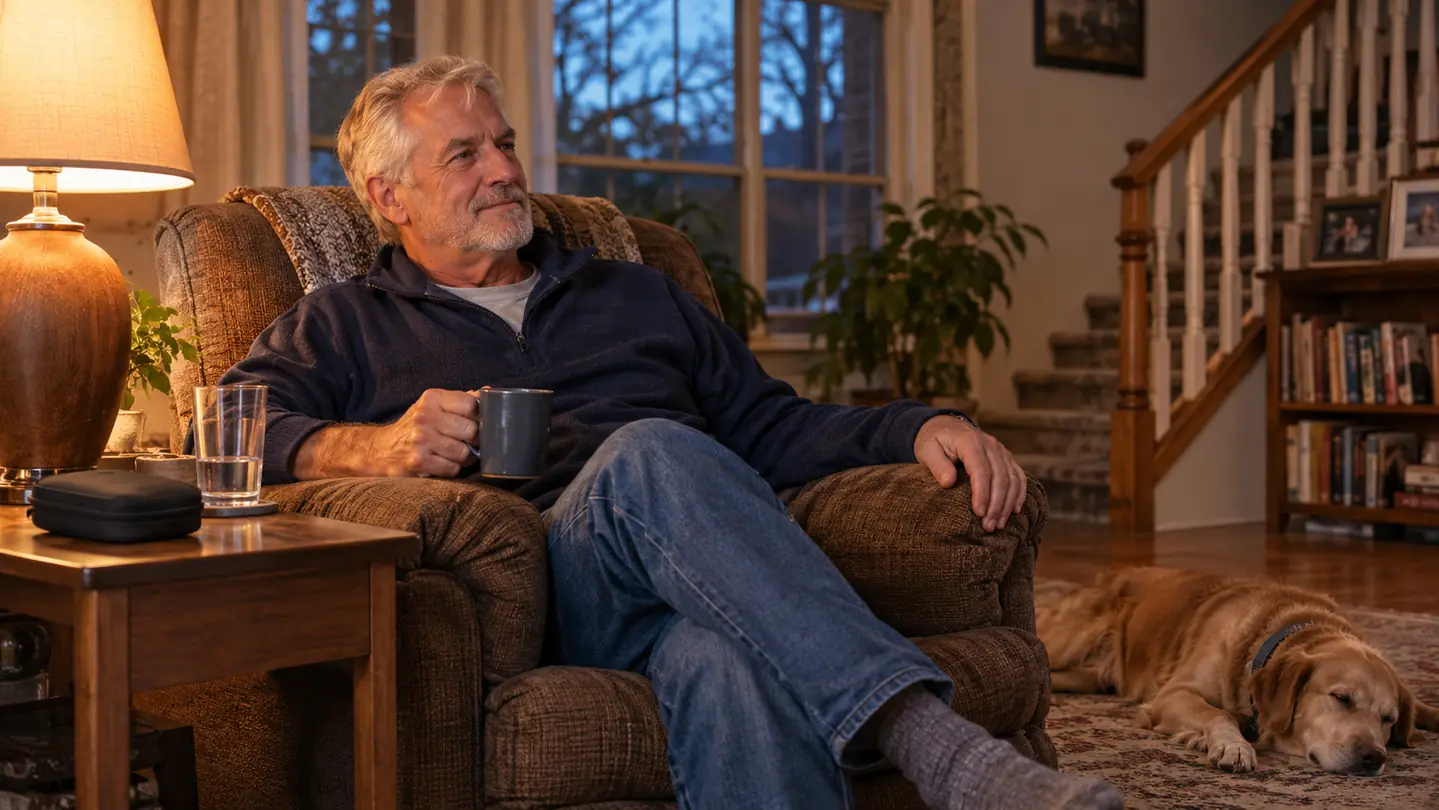
Nine months ago my orthopedist pulled the X-ray of my left knee up on the screen, leaned back in his chair, and told me what I already knew. The cartilage on the inside of that joint was mostly gone. Then he said something I did not expect. A TENS unit was a reasonable thing to try. Not a fix. Not a cure. Something to try, on a knee that had already tried plenty.
I am 63, a retired union pipefitter in St. Charles, Missouri, and I spent 31 years kneeling on concrete and climbing ladders for a paycheck. The left knee has osteoarthritis, diagnosed at 58. The right one had a meniscus trimmed when I was 47 and it is the good knee now. My dog Tater is a 70-pound yellow Lab mix who still expects two walks a day, and the stairs in this split-level house sit between me and both of them. Since February I have used the AUVON 24-mode unit in my recliner in the evenings, twenty to thirty minutes at a time, a few nights a week. Here is what nine months of that has been like.
The Quick Verdict
A rechargeable TENS unit that does one modest job honestly: it makes an evening with an arthritic knee easier to sit through. It will not fix the knee, and the pads are the part you will fuss with.
Amazon Check Today's Price →The Unit That Never Left the End Table
Nine months, a few nights a week, on a left knee with osteoarthritis. Nothing here is a cure and I am not a doctor. But if your own orthopedist or physical therapist says TENS is worth a try, this is the one I have run since February.
Amazon Check Today's Price on Amazon →How I've Used It
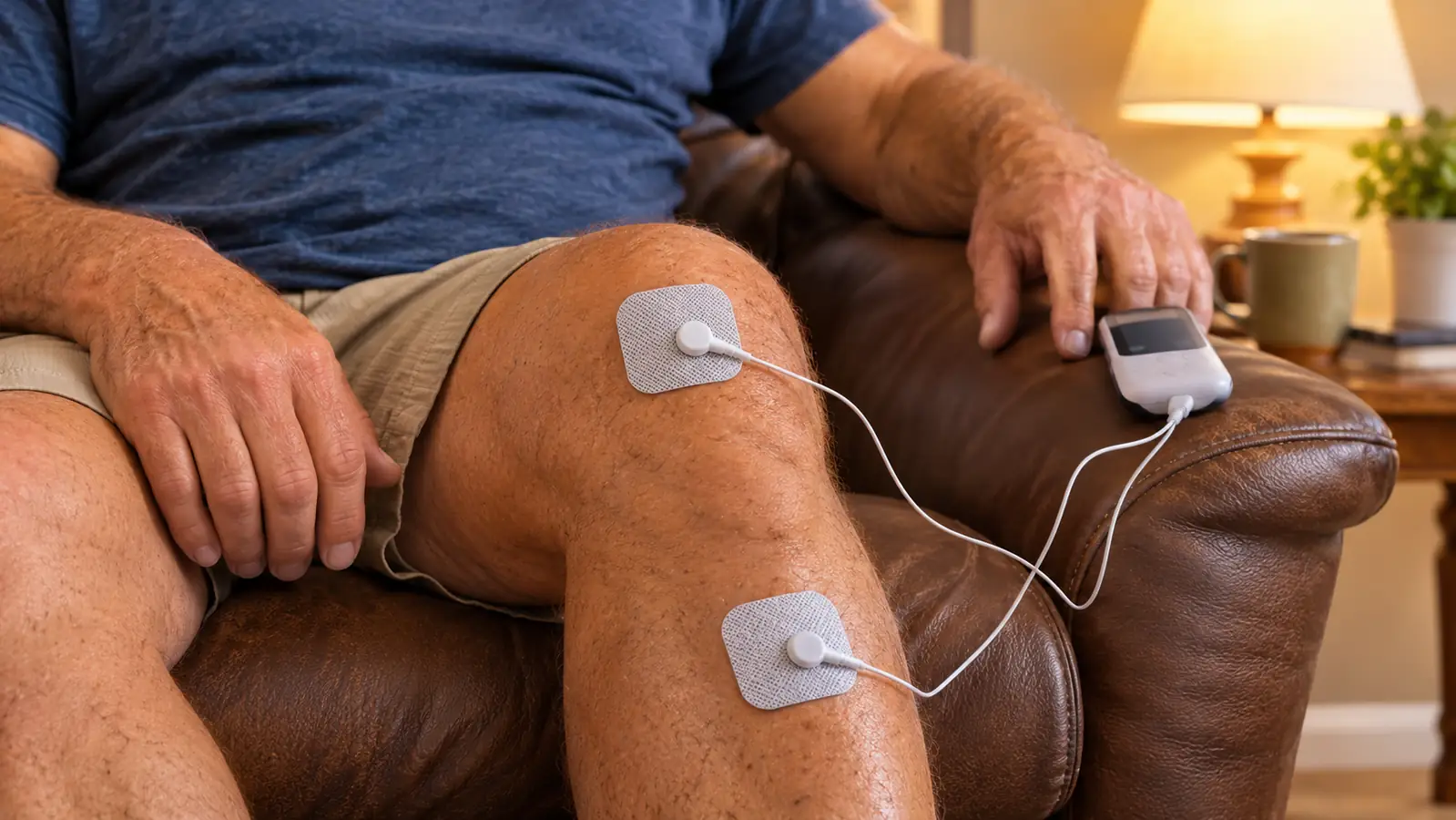
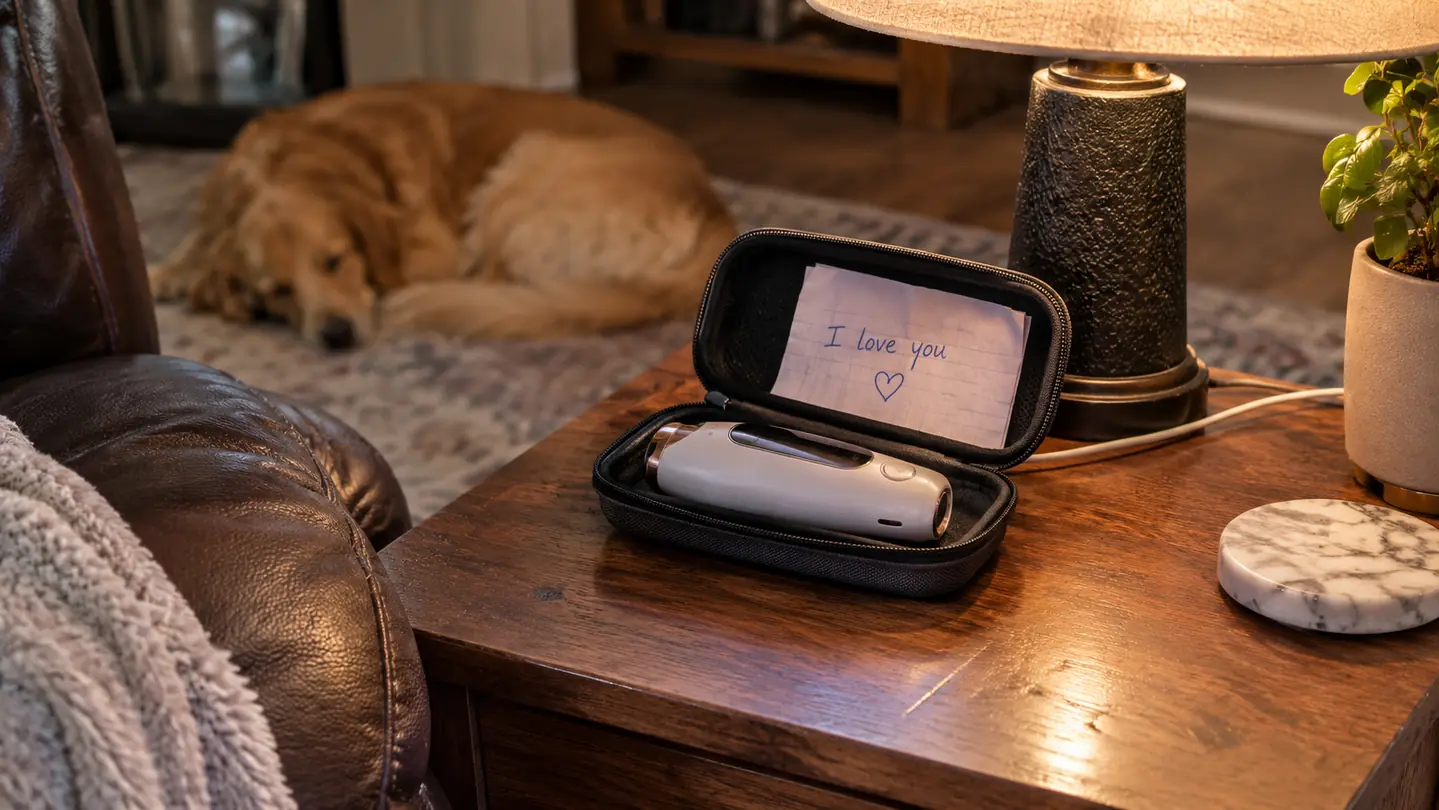
The physical therapist at the clinic showed me where the pads go and the one rule I have not broken since. Nothing directly over the kneecap. Around it, on the meat of the thigh above and the muscle below, yes. On the kneecap itself, no. She drew it on a sheet of paper with a felt pen, a rough oval for the kneecap and two dots on either side of it, and told me to keep the paper. That paper is still folded in the case nine months later, creased down the middle from being opened and shut a few hundred times.
I started the first week of February, on a Tuesday, with that drawing propped against the lamp and the little booklet open on the arm of the chair. I ran the intensity up faster than I should have and got a jolt that made me say a word Carol did not care for. Now I start low and creep up on it until I can just feel it working, and then I stop. That is the whole trick, and it took me about a week to learn it.
My routine is about as unglamorous as it gets. After supper I sit in the recliner, roll up the left pant leg, stick the pads on, clip the wires, and turn it up until I can feel it working and no further. Twenty to thirty minutes. Low intensity, always. Carol watches the clock more closely than I do, and Tater has decided that the twenty minutes I am pinned to the chair is the best part of his day, because he gets the footrest.
The AUVON lives in its case on the end table next to the recliner, with the charger plugged in behind it. I have never taken it into the pool at the Y, never into the shower, never out on the jon boat at Mark Twain Lake, and never to bed. It is a recliner device in my house, and that is all it has ever been. Setup takes me about three minutes if I do not dawdle. Cleanup is the pads going back onto their plastic sheet and the wires coiled around two fingers so they do not turn into a bird's nest in the case.
What the AUVON Is, and What It Isn't
Strip away the box and it is a small handheld device, roughly 5.87 by 3.19 by 2.44 inches and about 7 ounces, with a rechargeable lithium ion battery inside it. That battery is the reason I picked this one over the older units that eat AA batteries. Nine months in, I have never had it die in the middle of a session. There is a power indicator that tells you where the charge stands, and I have learned to glance at it before I sit down.
It has 24 pre-programmed modes. I want to be plain about that number, because it reads like more than it is. Twenty-four modes on a TENS unit is like forty channels on a television. You find two or three you like and the rest sit there forever. They are pre-programmed, which is the point. You are not dialing in your own waveform. You pick a program, you adjust the intensity, you sit.
What it is not: it is not a strengthening device, it is not a brace, and it is not going to rebuild anything. The osteoarthritis in my left knee is still there. My orthopedist was clear about that and so am I. What the unit does is give the nerves something else to report for half an hour. Whether that is worth having is a question each person answers for himself, and it is a question worth asking your own doctor before you spend anything.
The Modes, the Pads, and the Wires
The pads in the box are the upgraded gel type, and the adhesive on them is better than what came with a borrowed unit I tried a few years back. They stay put through a full session without wandering. Where they stop being pleasant is week three and beyond. Skin gets oily, pads pick up lint, and adhesion drops. I wipe them with a damp finger and let them air dry, and that buys a few more sessions before a new set. I got a little over a month out of the first set before they would not hold through a full session, and I have heard the same from other folks who use one of these nightly.
The wires are the thing nobody mentions on the product page. You are tethered to a box. If you stand up to let Tater out, you either unclip or you carry the box with you. The worst of it came in March, when Tater barked at the door mid-session and I stood up without thinking. The pad on my thigh came away with a sound like a bandage coming off and I had to start the whole thing over again. That is not a defect, it is the nature of a wired unit, but if you are picturing yourself moving around the house, adjust the picture before you buy.
The intensity control matters more than the mode does. On a bad night I want a setting I can feel clearly. On a night when the knee is only grumbling, that same setting is too much and I turn it down until it is barely there. Both of those are useful, and the unit has always had the range to reach both without me feeling like I am between settings.
Charging has never been a chore. I plug it in when the power indicator tells me it is low, which in my usage has worked out to roughly every couple of weeks, and I have never once been halfway through a session and had it quit. That sounds like a small thing. It is not a small thing. The borrowed unit I tried years ago took AA batteries and it always picked the worst night to go flat.
What Nine Months of Evenings Actually Did
Here is the honest version. On nights when my knee is throbbing after a long walk with Tater or an afternoon of yard work, the AUVON does not make the pain go away. What it does is take the edge off enough that I can sit still and watch a ballgame instead of shifting in the chair every four minutes. That is a smaller claim than the box makes, and it is the one I can stand behind.
There is one night I keep coming back to. It was a Saturday in April, the first warm one, and I had spent the afternoon hauling brush to the curb and then taken Tater the long way around the block because he had been cooped up all week. By the time the game came on I could not get comfortable in the chair at all. I put the pads on and sat there for half an hour and it did not fix a thing. But somewhere around the second quarter I stopped noticing the knee. That is the most accurate description I have of what this unit does. It does not remove the pain. It changes the subject.
It works better on the dull, achy evenings than on the sharp ones. If I overdid it and the knee is angry, half an hour of TENS will not talk it down. That is when the ice pack wrap comes out instead, cold for 15 or 20 minutes, and I leave the unit in its case. The two of them do different jobs and I reach for them on different nights. Ice for a knee that is puffy and hot. The AUVON for a knee that is just tired and complaining.
It also has not changed how far I walk or how long I stand on the dock. My distance is what it is. The unit makes the evening after easier, not the walking itself. Anything claiming more than that from a handheld box with stick-on pads is selling you something, and I have bought enough of those over the years to know the sound of it.
What surprised me is how quickly it became furniture. It is not a treatment I think about anymore. It is a thing I do after supper, like rinsing a dish. Some nights that makes it easy to keep up. Other nights it makes it easy to skip, and I have done plenty of both.
Where It Fell Short
First shortfall is patience. This is a device you set up, wear, and put away every time. Twenty minutes of sitting still with wires running down your leg is not nothing in an evening, and I have skipped plenty of nights because I did not feel like fooling with it. There was a stretch in June, two or three weeks of it, where the case sat on the end table unopened while I told myself I would get to it tomorrow. Consistency is the whole game with something like this, and consistency is exactly what a wired gadget makes difficult.
Second, the pads are a running chore. They need care between sessions and replacing eventually, and the replacing never happens on a schedule that suits you. You find out at seven in the evening when one will not stick and the ballgame starts in ten minutes. If you are the kind of person who will not wipe a pad down and store it on its plastic sheet, you will be unhappy inside a month and you will blame the unit for it.
Third, there is no timer on the ceiling of the evening. Twenty minutes can turn into forty if I fall asleep in the chair, because the thing does not stop itself and Carol does not always catch it. I have woken up an hour later with the pads still buzzing away and a red patch where they sat. Set your own clock. It is on you, not on the device.
Fourth, and this is what I would tell a friend first: it does nothing while it is off. There is no carryover I can detect. The knee on Tuesday morning is the same knee it was before I used the unit Monday night. That is not a knock on AUVON. It is what TENS is, and anybody telling you different is selling a story.
On nights when my knee is throbbing after a long walk with Tater or an afternoon of yard work, the AUVON does not make the pain go away. It takes the edge off enough that I can sit still and watch a ballgame instead of shifting in the chair every four minutes.
What I Liked
- Rechargeable lithium ion battery, so no hunting for AA batteries mid-session
- Twenty-four pre-programmed modes, with enough intensity range for both a bad night and a mild one
- Upgraded gel pads stay put through a full 20 to 30 minute session
- Small and light enough to live in a case on the end table, about 7 ounces and under six inches long
- Power indicator tells you where the charge stands before you sit down
- Nine months in, it has never quit partway through a session
Where It Falls Short
- No carryover that I can detect. The knee feels the same the next morning
- Wired pads mean you are tethered to the unit while you use it
- Pads need wiping and eventual replacing, and adhesion drops with skin oils and lint
- Twenty-four modes is more than anyone needs, and most go untouched
- It only works if you keep a routine, and skipping nights thins out the results
- Nothing stops a session on its own, so it is up to you to watch the clock
Who This Is For
This is for someone with a knee that aches in the evening, who has already been told by a doctor or a physical therapist that a TENS unit is reasonable to try, and who is willing to sit still for half an hour a few nights a week. It suits people who are not looking for a cure and know it. If you already ice, already do the exercises your PT handed you, and want one more tool to get through the evening, the AUVON earns its spot on the end table. It also suits a household where the chair, the lamp and the end table are in the same place every night, because that is where this thing gets used and nowhere else.
Who Should Skip It
Skip it if you want something you can wear while you work, walk, or fish. This is not that. Skip it if nobody has cleared it with your doctor, particularly if you have a pacemaker or any implanted device, because that is a conversation for a medical professional and not for a product page or for a retired pipefitter with a keyboard. Skip it if you will not keep a routine. And skip it if you are expecting the arthritis itself to improve. Nine months in, mine has not, and I never expected it to.
One More Tool on the End Table, Not a Cure
Nine months, a few nights a week, twenty to thirty minutes at a time. If your orthopedist or physical therapist says TENS is worth trying, the AUVON is the unit I have used, and it is still plugged in behind my recliner.
Amazon Check Today's Price on Amazon →