
Three in the morning is a bad time to make decisions, and I made the same one for the better part of a year. I would roll onto my side, feel my knees press together, and lie there listening to my left knee carry on until I gave up and moved to the recliner. Carol knew where to find me. Tater, our yellow Lab mix, knew too, and he would get up on the footrest with me and go back to sleep while some Chiefs game from a season ago played to an empty room.
I am not a doctor, and nothing here is medical advice. I am 63, retired after 31 years as a union pipefitter, most of it kneeling on concrete and climbing ladders. My left knee has osteoarthritis in it, diagnosed when I was 58. My right knee had a meniscus trimmed back when I was 47, and it is the good one now. What I know about knees is what a man learns from living inside one. So when Carol brought home a Contour Legacy leg and knee pillow about two years ago, I gave it the same look I give most things she brings home, and then I used it anyway. It has been between my knees nearly every night since.
The Quick Verdict
A soft memory foam pillow that keeps my top knee from dropping onto the bottom one. It cut my 3 a.m. wake ups from every night to once or twice a week. It is not a brace, not a treatment, and it will not save a bad mattress or a bad sleep position.
Amazon Check Today's Price →What finally got me out of the recliner at 3 a.m.
Two years of sleeping on the Contour Legacy knee pillow, and it is still the quietest piece of gear in my knee drawer. If you are a side sleeper whose knees press together all night, this is the one I would start with.
Amazon Check Today's Price on Amazon →How I've Used It
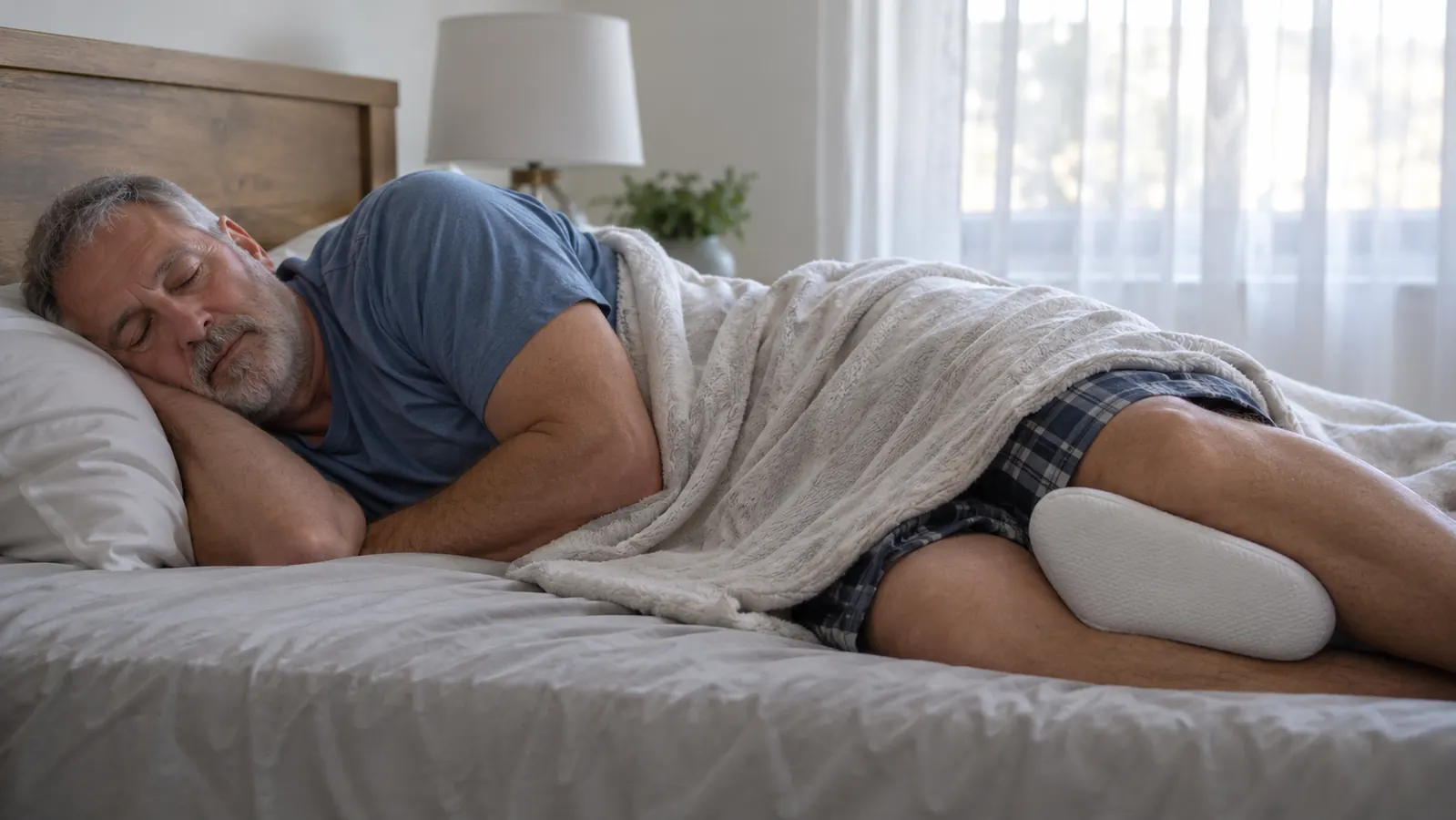
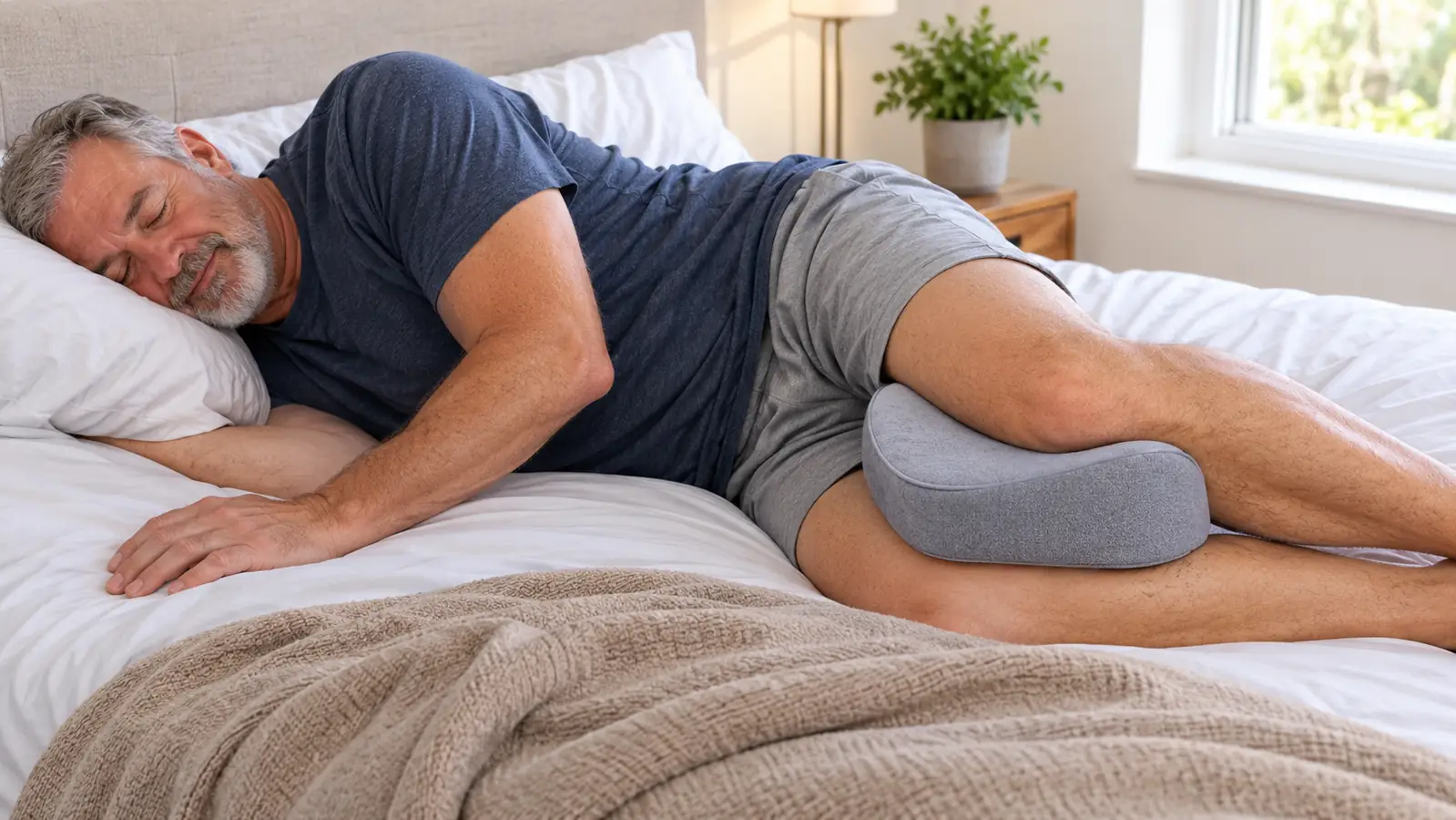
The pillow lives on my side of the bed, the left side as you look at it from the footboard. I am a side sleeper and always have been. The way it works for me is simple. I roll onto my left side, tuck the pillow between my knees, and it holds the top leg roughly level with the bottom one instead of letting it drop forward. That drop is what my knee hates. When the top leg slides ahead, the knee twists, and by two in the morning I am awake and unhappy about it.
I use it every night at home. It travels with me on the overnight fishing trips to Mark Twain Lake, which is the only time it leaves the house. It does not go in the jon boat, because it is a pillow and the boat is wet. There is nothing to fasten or adjust and nothing to fiddle with in the dark, which matters more at 63 than I would have guessed at 40. I put it between my knees and that is the whole routine.
Two years is long enough to know how something holds up in a house. The foam has softened a little where my knees sit, but it has not gone flat and it has not turned into the pancake my old bed pillow became after a few months of the same job. The cover comes off and goes in the wash, and it has been washed plenty. I will get to the wear report later, because it is a real thing and not a small one.
What the Contour Pillow Actually Is
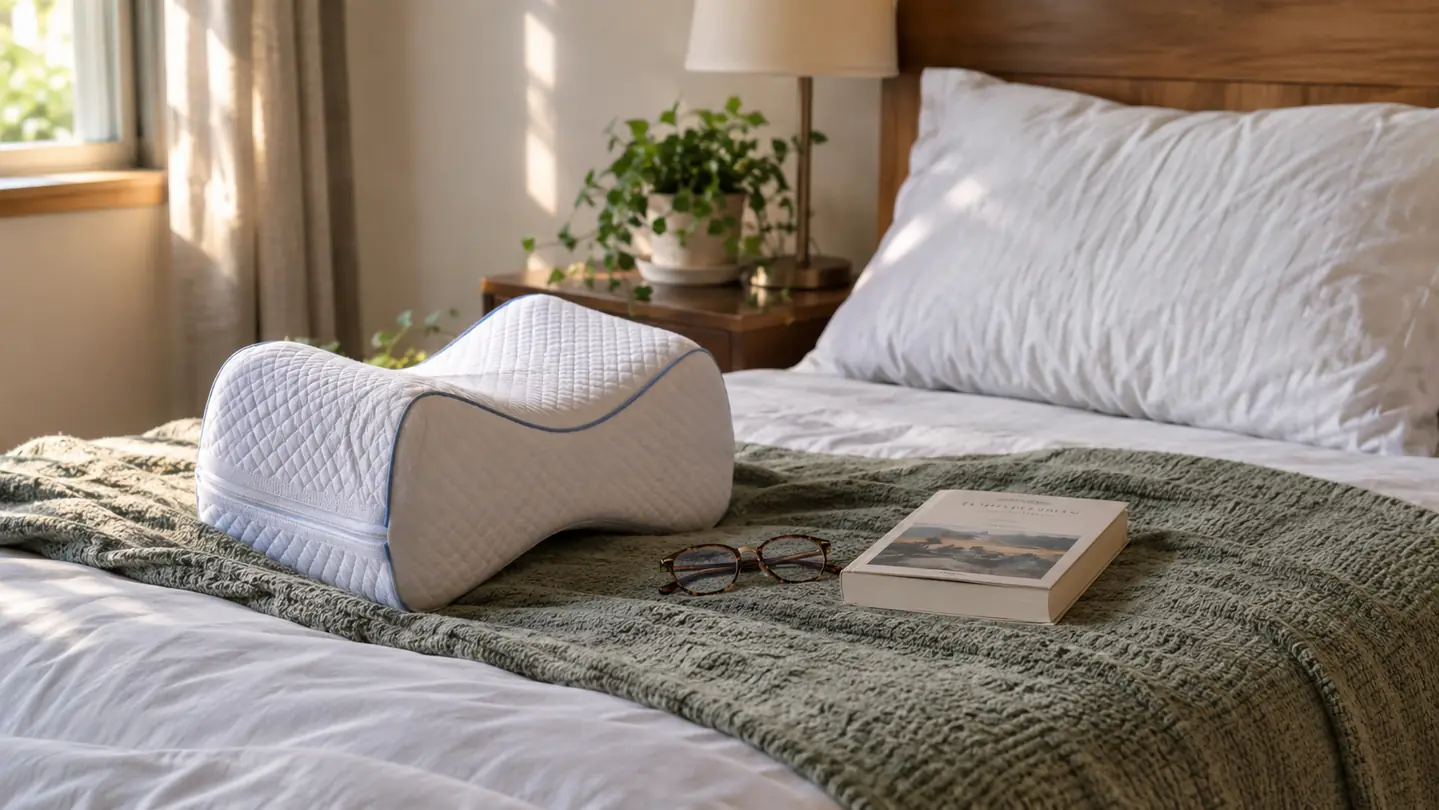
It is a foam pillow, not a brace, and that distinction matters more than the listing copy lets on. It measures 10 inches long by 9.5 inches wide. The fill is memory foam, the firmness is rated soft, and the whole thing weighs 198 grams, about seven ounces, which is light enough that I have knocked it off the bed in the dark and not noticed until morning. The cover is 62 percent polyester and 38 percent lyocell, and it is washable. Contour lists a temperature regulating foam that pushes heat outward, plus a one year manufacturer warranty.
The temperature part deserves an honest word. I run warm. Foam against the back of the knees for eight hours can get clammy, and this one is better about that than the cheap bed pillow I used before it, but it is not a cooling pad. On a hot night in July I still flip it over once. That is a small complaint and I am not going to dress it up as anything bigger.
Side Sleeping and Why My Knee Complains
When you sleep on your side and your top leg slides forward, three things happen at once. Your top knee comes down against your bottom knee. Your hip rotates. Your lower back picks up a twist it does not want. Do that for six or seven hours a night for years and it adds up, especially when one of those knees already has arthritis in it. My left knee is the bottom knee when I sleep on my left side, and it took the worst of it.
A pillow between the knees keeps the top leg closer to level. That is the entire theory, and it matches what I felt. The knee on the bottom stops getting leaned on. The hip does not rotate as far. I am not going to tell you it fixed my back, but the mornings got easier, and the difference showed up in the first month rather than the first year.
The First Three Weeks Were Not Good
I want to be straight about this because most write ups skip it. The first stretch with a pillow between your knees is not comfortable. It feels like something is in the way, because something is. My top knee did not want to rest at the height the pillow put it, and I woke up more than once with the thing on the floor and no memory of pushing it there.
The fix, for me, was placement. I had it too far down toward the calf at first, which levered my knee instead of supporting it. Moving it up so it sat from just above the knee to mid thigh made the difference. Carol suggested that, and I let her think it was my idea. If you try one of these and quit after four nights, you probably had it in the wrong spot, or you are a back sleeper.
By the end of the third week I was sleeping through most nights. Not all of them. Most. The 3 a.m. wake up went from every night to maybe once or twice a week, and the ache when I swung my legs out of bed had backed off enough that I stopped noticing it as the first thing in my day.
What I Tried Before This
Before the Contour pillow I used a regular bed pillow folded in half, which works for about a week and then goes flat. I tried a rolled up fleece blanket, which slid out from between my knees every time I turned over. I tried a small cushion off the couch, which was better than nothing and worse than everything else. The problem with all of them is that they were not made for the job. They were either too soft to hold the leg up or too big to stay put.
What the Contour pillow has that a folded bed pillow does not is a shape that stays where you put it and foam that pushes back. It is not complicated engineering. It is the right size for the space between two knees, and it holds that space all night instead of collapsing into it.
What Changed Over Months
The knee is the reason I bought in, but the surprise was my lower back. Sleeping with the knees stacked and the top leg hanging forward does something to your hips and your low back over a night, and holding the leg level takes that twist out. My back felt less cranky in the mornings. I cannot prove the pillow did that. It is the only thing that changed in that stretch, though, and I am reporting it as I found it.
The 3 a.m. wake ups went from every night to maybe once or twice a week, and that was before the first month was out.
Where it helped less: on the stairs, in the boat, on the dock. This is a sleeping pillow. It does nothing for a knee that has to carry 200 odd pounds down a flight of steps, and I never expected it to. That is what the brace in my tackle bag is for, and the ice pack and the sleeve in my dresser drawer. The Contour has one job and it does that job in bed.
What It Does Not Do
It does not treat arthritis. My left knee still has osteoarthritis, it still aches in cold weather, and it still tells me about it after a long walk with Tater. What the pillow does is remove one specific source of pain, the overnight grind of knee against knee, and that turned out to be a bigger slice of my problem than I knew. My orthopedist is fine with it. The physical therapist who showed me my exercises is fine with it. Neither one of them called it a treatment.
It also will not save a bad mattress or a bad position. If you sleep on your stomach or flat on your back, a pillow between the knees is not doing anything for you. If you flip positions all night, you will spend half of it hunting for the thing in the sheets. And if your knee pain is sharp, or new, or comes with swelling and heat, go see somebody. A foam pillow is not the answer to that, and I would be doing you a disservice to pretend otherwise.
How It Has Held Up Over Two Years
Here is the honest wear report. The foam has taken a set where my knees rest. It is not as tall as it was in the first year, maybe a quarter inch, and the cover has some pilling on the side that faces the sheet. Nothing has torn. Nothing has split. It still does the job, and it still gets washed about once a month. At two years I would buy it again rather than try something else, which is about the highest compliment I can give a piece of gear.
One thing I did not expect: it is the piece of gear I notice least, which is the point. The brace gets noticed because I only wear it on fishing days. The ice pack gets noticed because it is cold. The Contour pillow just sits there between my knees and does its quiet work, and on the nights it is missing, usually because I left it in the truck after a trip, I feel it by two in the morning.
What I Liked
- Keeps my top knee from dropping onto the bottom one, which was the actual cause of my 3 a.m. wake ups
- Foam has held its shape for two years with only a small set where the knees sit
- Cover is washable and has survived two years of regular washing
- Light enough to pack for overnight fishing trips, nothing to fasten or adjust in the dark
- Listing carries a one year manufacturer warranty
Where It Falls Short
- The first two to three weeks were uncomfortable while I worked out placement
- Runs warm against the back of the knees on a hot night
- Does nothing for stairs, the boat ramp, or any waking hour knee pain
- Slides out of the sheets if you change positions a lot at night
Who This Is For
Side sleepers with a cranky knee, hip or low back, especially if you wake at roughly the same time every night with the knee aching. It suits people who sleep on one side most of the night and stay there. It suits anyone whose knees press together when they roll over. It suits the 63 year old version of me who did not want another doctor visit, he just wanted to sleep through until the alarm. And if Carol style nagging is what gets you to try it, that is fine too. It is the least fussy thing in my knee drawer, and the one I would hand to a friend first.
Who Should Skip It
Back sleepers and stomach sleepers, for a start. The pillow needs your knees stacked, and if they are not, it is just a lump in the bed. If you change positions six times a night, skip it. If your knee pain is new, sharp, or comes with swelling, skip it and go see a doctor, because this will not tell you anything a professional should be telling you. And if the real problem is a mattress with a divot in it, a pillow is not going to outweigh that.
Two years in, it still sleeps between my knees
If you have been folding a bed pillow in half every night and waking up anyway, this is the version of that idea that holds its shape until morning. Same job, better tool.
Amazon Check Today's Price on Amazon →