
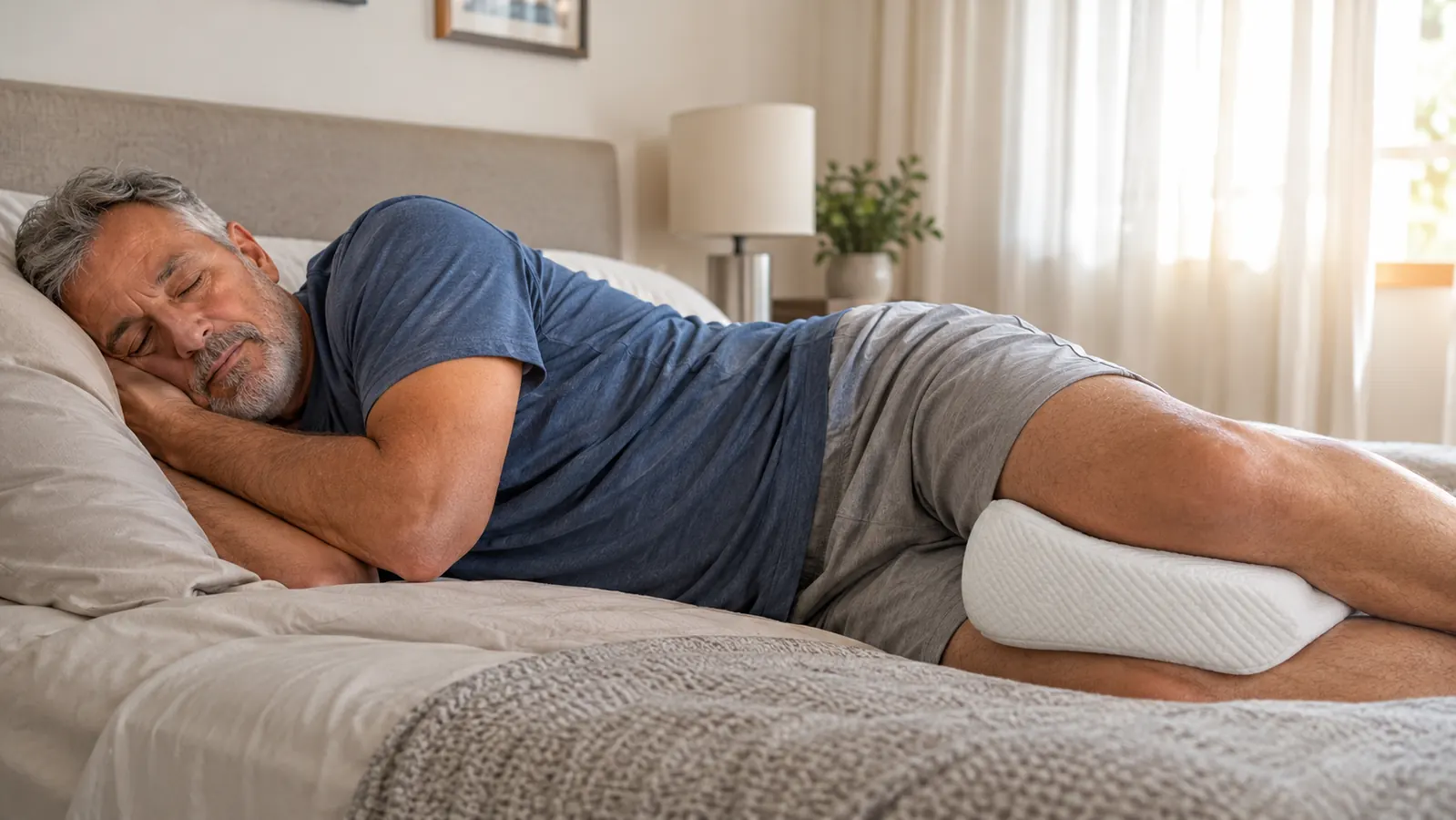
The first thing nobody tells you about a knee pillow is that it will not make your knee new. I am 63, I have osteoarthritis in my left knee, and I have slept on my side for as long as I can remember. For years my knees would find each other in the night and I would wake around 3 a.m. with that deep ache that makes you change positions six times and stare at the ceiling. Carol, my wife, got tired of hearing me complain. About two years ago she found the Contour Legacy leg and knee foam pillow and put it on my side of the bed. I did not expect much. I had already tried a folded bath towel and a regular bed pillow between my knees. Both ended up on the floor by morning. The Contour stayed. That is the short version. This is the longer one, including the parts that are not flattering.
I am not a doctor. I am a retired union pipefitter from St. Charles, Missouri, and I spent 31 years kneeling on concrete and climbing ladders. My left knee was diagnosed with osteoarthritis at 58. My right knee had a meniscus trimmed back when I was 47, so the right one is the good one now. Tater, my 9-year-old yellow Lab mix, still wants two walks a day, and that is the real reason my knees matter to me. I need to get down the stairs, around the block, and into a 14-foot jon boat on Mark Twain Lake without thinking about it. The Contour is one part of that. It is not the whole thing. I still do the exercises my physical therapist showed me, and my orthopedist still calls the shots.
The Quick Verdict
A simple, soft foam pillow that stopped my knees from pressing together at night. It is not a brace and it will not fix daytime pain, but after two years it is the one item I would replace the same day if it wore out.
Amazon Check Today's Price →The Contour stopped the 3 a.m. knee-on-knee ache I had learned to live with
It is a foam pillow, not a medical device. For me that was enough. If your knees knock together in the night, see what the current listing says about size, cover and warranty before you decide.
Amazon Check the Contour Legacy Pillow on Amazon →What the Contour Legacy Is, and What It Is Not
The Contour Legacy is a foam pillow designed to go between your legs and knees while you sleep on your side. The listing says it supports both legs and knees. The fill is memory foam, the firmness is listed as soft, and the cover is 62 percent polyester and 38 percent lyocell. It measures 10 inches long by 9.5 inches wide and weighs 198 grams, which is about 7 ounces. The cover is washable. Contour backs it with a one year customer care manufacturer warranty.
What it is not is just as important. It is not a knee brace. It is not an ice pack. It is not a TENS unit. It will not stabilize your knee when you step off a dock or go down the stairs. It is not going to rebuild cartilage or replace the work my physical therapist gave me. The Contour has one job in my house: keep my knees from pressing on each other while I sleep. When I ask it to do that job, it does it. When I ask it to do more, it does not.
The listing also mentions temperature regulating foam technology that pushes heat outward, away from your body. I sleep warm, and I have not noticed the pillow turning into a hot brick the way some foam can. That is my experience, not a promise. The cover feels like a soft fabric, not a slick sheet, and it has held up to regular washing. After two years the foam is a little softer than it was on day one. That is normal for memory foam and it is worth knowing before you buy.
How I've Used It for Two Years
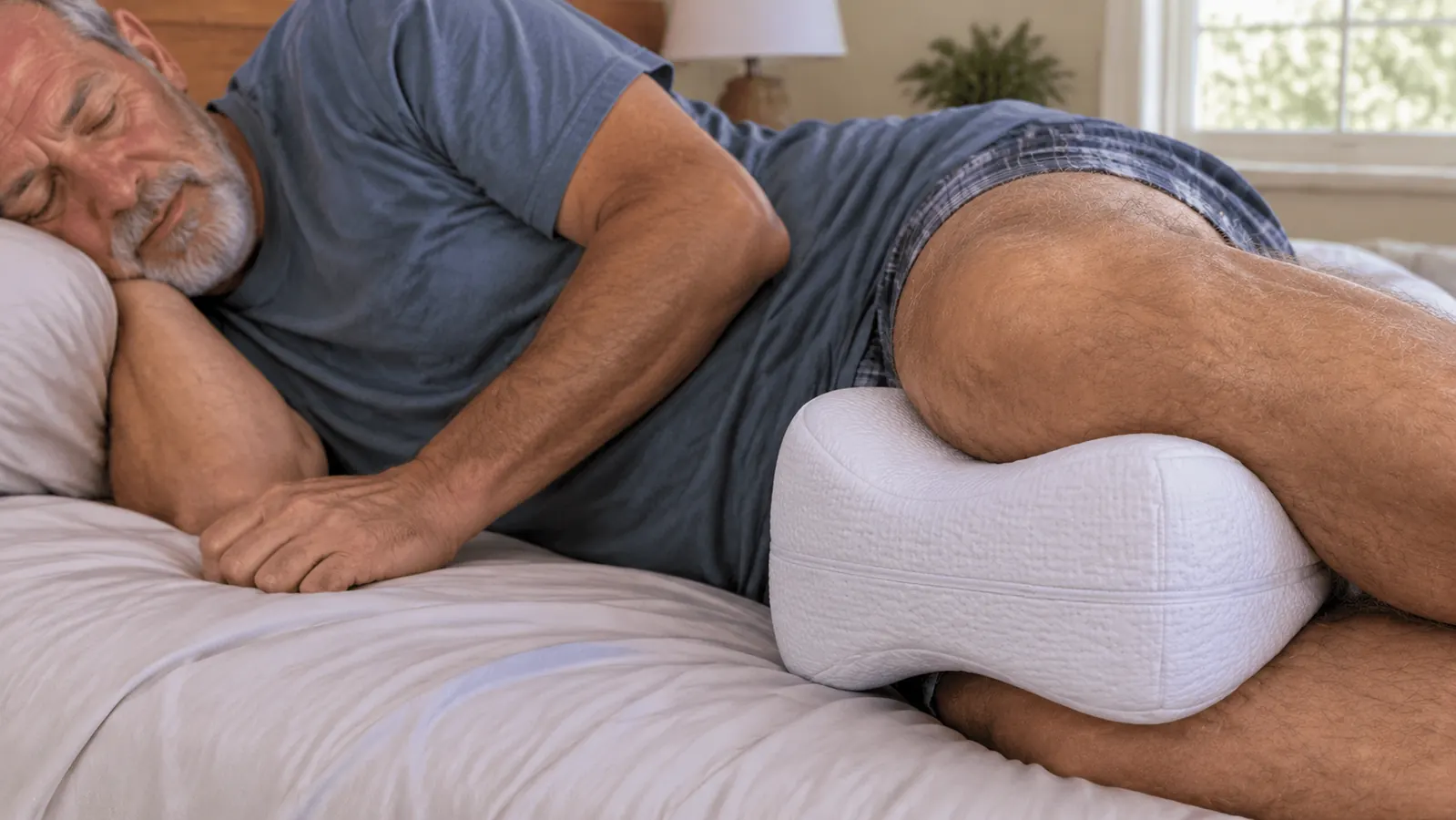
I use the Contour every night. I sleep on my side, usually my left side, with the pillow between my knees. Before the Contour, my knees would touch and the pressure would build until I woke up. It was not a sharp pain. It was a deep, tired ache that made me kick the covers off and change positions. Carol says I used to sound like a washing machine with an unbalanced load. The first week with the pillow felt strange. I had to get used to the width between my knees. By the second week I noticed I was not waking at 3 a.m. as often. That is the honest result. Not every night is perfect, but the 3 a.m. wake-ups went from most nights to maybe once or twice a week.
I keep it on my side of the bed, and I take it on overnight fishing trips. It fits in my duffel without taking over. At home it stays put well enough, but it is a pillow, not a clamp. If I thrash around, it can end up on the floor. That happens less than it did with a regular pillow because the cushion gives my knees something to hold. I wash the cover every couple of weeks, more often in the summer. It goes back on without a fight. The foam itself I spot clean and let air out. I have not put the foam in the washing machine and I would not.
One thing I want to be clear about: the Contour is a nighttime tool. It does nothing for me when I am walking Tater, standing on the dock, or climbing the stairs in my split-level house. For those jobs I use other things. The Contour stays in bed. That division of labor is the reason I still like it. I do not expect a pillow to do a brace's job, and I do not expect a brace to do a pillow's job.
The Contour did not fix my knee. It fixed the way my knees met in the night, and that was worth more sleep than I had gotten in years.
Firmness, Fit, and Size
The Contour is listed as soft, and that is accurate. It is not a rigid block. When you put it between your knees, it gives. For me that is the right feel. A hard pillow would make my hips feel out of line. The soft memory foam lets my knees rest against something instead of knocking together. It also means the pillow is not going to force your leg into a position. It is a cushion, not a correction.
The catch is that soft is not for everyone. If you want a firm support that holds your leg at a set angle, this is going to feel too squishy. If you are a larger person or you have very heavy legs, you may compress it more than I do. After two years the foam still has enough life to do the job, but it is softer than it was. I would not call it a hard support. I would call it a soft separator that keeps my knees from touching.
The cover matters more than I expected. The 62 percent polyester and 38 percent lyocell blend feels smooth and breathes better than the old cotton pillowcase I used to stuff between my knees. I wash it on a normal cycle and dry it on low. It has not pilled up or shrunk. The foam has a slight smell when it is new, which faded after a few days. If you are sensitive to smells, air it out before the first night.
The Contour is 10 inches long and 9.5 inches wide. That is not a body pillow. It is not going to run from your knees to your ankles. It sits between your knees and maybe a little above and below. For me that is the right size. A bigger pillow would push my legs too far apart and make my hip ache. A smaller one would slip out. The 10 inch length gives my knees a landing spot without turning me into a triangle.
Because it is only 198 grams, it is easy to move. I can grab it in the dark and put it where I want it. It does not feel like I am wrestling a piece of furniture. That also means it can slide if you are a restless sleeper. I have found it under the covers near my feet a few times. I put it back. It is not a big deal, but nobody should buy this expecting it to stay glued to your legs.
If you are tall, you may want more length. If you are short, the 10 inch length may feel like more than you need. It works for me. Carol has no knee problems, so she has never used it. Tater has tried to lie on it once, which is the closest thing to a second opinion I can offer. The dog is not a reliable reviewer.
Where It Helps Me, and Where It Does Not
It helps most at night. My left knee has osteoarthritis, and the right knee is the good one after the meniscus trim. When I sleep on my side, the left knee wants to rest on the right one. That pressure is what woke me up. The Contour gives the left knee a soft place to land so it is not pressing on the right. I wake up with less of that deep ache. I would not say my knee feels new in the morning. I would say it feels less beat up than it did before.
It does not help with the first few steps down the stairs in the morning. It does not make my knee less stiff after sitting through a Chiefs game. It does not help me get in and out of the jon boat. For those things I use a compression sleeve on walks, a brace on fishing days, an ice pack after, and the TENS unit in the evening. The Contour is the sleep piece. That is all it is. If you buy it expecting it to replace the other stuff, you will be disappointed.
It also does not fix the way I sleep. I still roll from side to side. I still wake up sometimes. I still have a bad night when the weather changes or when I overdo it in the yard. The difference is the bad nights are less frequent. The Contour is not a switch that turns off knee pain. It is a tool that removes one source of pressure. For me that source was a big one.

The Things Nobody Tells You
The first week is not magic. You have to get used to sleeping with something between your knees. It felt bulky at first, and I had to adjust it a few times a night. If you give up after two nights, you will not know if it works. I would give it a full week, maybe two. The body has to learn a new sleep position. That is not a sales pitch. It is just what happened to me.
It will get softer. Memory foam does that. After two years mine is not the same pillow it was out of the package. It still works, but if you want a firm feel forever, this is not that. The one year warranty covers defects, not normal softening. I have not had to use it. I am just telling you what the listing says.
It is not for back sleepers or stomach sleepers. The whole idea is to put something between your knees while you are on your side. If you sleep on your back, the pillow will just be in the way. If you sleep on your stomach, it will be under you and you will hate it. The title says side sleepers for a reason. I am a side sleeper. That is why it works for me.
You will still need to see your doctor or physical therapist. I am not a doctor. I am a retired pipefitter with a bad left knee and a dog who expects a walk. The Contour is not a treatment plan. It is a pillow. It helped me sleep, and better sleep helped me keep up with the rest of my routine. That is the honest chain of events.
What I Liked
- Keeps my knees from pressing together, which cut my 3 a.m. wake-ups
- Soft memory foam feels comfortable between the knees, not like a hard support
- Washable cover is easy to remove and holds up
- Light at 198 grams, so it is easy to move and pack for overnight trips
- Temperature regulating foam has not made me sleep hot
- One year manufacturer warranty backs it
Where It Falls Short
- Soft firmness will feel too squishy if you want rigid support
- No strap or attachment, so it can slide out of place on restless nights
- Only useful for side sleeping, not back or stomach sleepers
- Foam softens over time, which is normal but worth knowing
- Takes a week or two to get used to
Who This Is For
If you sleep on your side and your knees knock together, this is worth a try. That is the reader I picture. You are 50 or older, your knee is not bad enough for surgery but bad enough to wake you up, and you do not want another gadget with straps and batteries. The Contour is simple. You put it between your knees and go to sleep. It is also for people who travel a little and want something that fits in a bag. It is for people who understand it is a comfort item, not a medical device. If that sounds like you, the Contour is the first thing I would try at night.
Who Should Skip It
Skip it if you need firm, rigid support. Skip it if you sleep on your back or your stomach. Skip it if you want something that will stay clamped to your legs all night. Skip it if you expect it to help with daytime pain, stairs, or walking the dog. And skip it if you are not willing to give it a week or two. The Contour is not for everyone. It is for a side sleeper with knee-on-knee pressure who wants a soft cushion and nothing more. If your doctor or physical therapist has told you to use a specific support at night, follow that advice instead. They know your knee. I know mine.
If your knees meet in the middle of the night, the Contour is the simplest fix I have found
I have used it for two years. It is soft, washable, and light enough to take on a fishing trip. It is not a brace and it is not a cure. It is the pillow that stays on my side of the bed.
Amazon See the Contour Legacy Pillow on Amazon →